
“Details that could throw doubt on your interpretation must be given, if you know them. You must do the best you can—if you know anything at all wrong, or possibly wrong—to explain it. If you make a theory, for example, and advertise it, or put it out, then you must also put down all the facts that disagree with it, as well as those that agree with it. There is also a more subtle problem. When you have put a lot of ideas together to make an elaborate theory, you want to make sure, when explaining what it fits, that those things it fits are not just the things that gave you the idea for the theory; but that the finished theory makes something else come out right, in addition.
“In summary, the idea is to try to give all of the information to help others to judge the value of your contribution; not just the information that leads to judgment in one particular direction or another.
“The easiest way to explain this idea is to contrast it, for example, with advertising.”
— Dr. Richard P Feynman, “Some remarks on science, pseudoscience, and learning how to not fool yourself“, 1974
Over these past few weeks, circumstances have obligated me to revise — and re-revise — the thesis of this third and final installment in my trilogy of posts about Manitoba’s 2023 general election. I cannot tell you what joy it has brought me!
You must understand, it has been my — perhaps glaringly obvious — opinion, throughout very nearly the entirety of the past four months, that the Progressive Conservative Party of Manitoba would form government once again, and that Heather Stefanson would cement her place in history as the first woman to be elected Premier by the people of Manitoba.
That will not be so — but not for lack of trying. To prosecute their campaign, the PC Party of Manitoba had amassed a dread arsenal of cash and consultants; a veritable who’s who of “who are these hacks?”.
As previously detailed in Parts I and II, the PCs (and their allies) had also eagerly adopted many of the emergent, data-driven voter-targeting tactics which have proven instrumental to recent electoral wins by right-wing politicians elsewhere in Canada (to say nothing of other jurisdictions).
Opposing them, the Manitoba NDP can charitably be said to have “started as they meant to go on” in pursuing their own electoral strategy online. The uncharitable take would be that the party embraced “healthcare fetishism”; the Dippers’ pitch to Manitoba voters focused centrally, almost solely, on this key theme, while largely eschewing other ostensibly ‘marginal’ topics such as the environment, provincial-Indigenous relations, or trade. An emphatically one-note affair.
In the days and months to come, the scale of the provincial NDP’s election-night victories under party leader Wab Kinew may perhaps be credited to this “bold” electoral strategy. Although that is not strictly speaking an inaccurate characterisation, I would consider it inapt. Whatever “boldness” I witnessed in the conduct of the Manitoba NDP’s digital campaign would be akin to the “boldness” one recognises in fielding an army of cavalry and field cannon in the era of drone warfare.
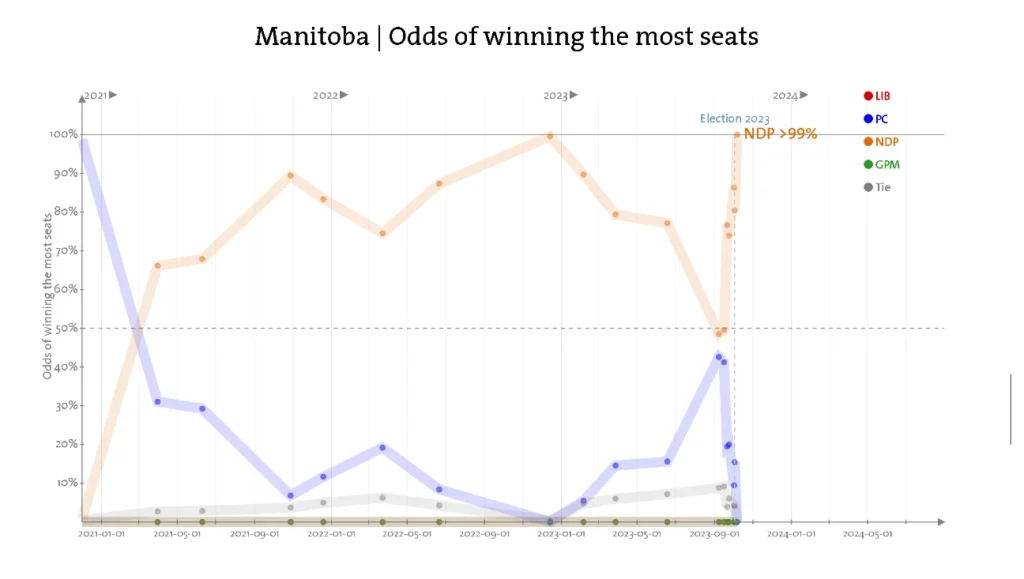
All of which is to say: this was not your box-standard, run-of-the-mill glass-cliffing. Despite Premier Stefanson’s consistently rock-bottom personal approval ratings, many months of careful and assiduous “message discipline” on the part of the provincial Tories had only just begun bearing fruit, as recent opinion polls had shown a fairly consistent upward trend in PC support both throughout the year to-date and into mid-summer, as the provincial campaign entered its final days.
As recently as two weeks prior to Election Day, I remained wholly — and miserably — convinced of the inevitability of another Progressive Conservative government here in Manitoba. How, then, do I reconcile the actual election-night results with my own dim assessment of the victor’s campaign, or the seemingly insurmountable advantages I had perceived in the PC Party’s campaign machine (both in resources and in capabilities)?
Who, in other words, has “botched it” more here: the PCs, or myself?
A Funny Thing on the Way to Jena–Auerstedt
Stop me if you’ve heard this one: a man asks of his friend, “How did you go bankrupt?”. “Two ways,” his friend replies: “gradually and then suddenly”.
That’s the famous, pithy bit. But the passage of Hemingway from which it comes goes on; the first man presses his friend further. “What brought it on?”, he asks. “Friends” comes the response, “I had a lot of friends. False friends. Then I had creditors, too.”
In Part II of this trilogy, I described the various “political” ad campaigns executed via the Government of Manitoba’s official Meta account(s) prior to the formal “blackout period” on government advertising. That post made little mention (perhaps none?) of my thoughts on the interplay between the content of those “public advertising” campaigns, paid for by the public, and the partisan campaign messaging coming from the PC Party of Manitoba. I can assure you, this was an omission borne out of expedience moreso than insufficiency; that interplay was the subject of its own dedicated appendix in the formal complaint which I have since written to Manitoba’s Commissioner of Elections.
I won’t reproduce that letter here in full — I do wish the Commissioner would confirm its receipt, though — but here are a few relevant excerpts:
- It merits note that several of the “key messages” of recent Manitoba Government political advertising were first detected/observed in ad creatives paid for and delivered via the official Meta account(s) of the Manitoba Progressive Conservative Caucus.
- One such ad, which ran from March 9-16, 2023, includes the earliest known uses (in recent memory) by either the PC Party or the MB Government of phrases such as “historic help”, “safer streets”, “healing healthcare”, etc.
[…]
In closing and in summation, I appreciate that the pattern of activity described above – and illustrated further in the enclosed appendices – invites a number of questions to which I do not have firm answers. Among them:
[…]
- Which of the creatives flighted via the Manitoba Government’s official Meta account(s) – or perhaps more aptly, what proportion of these creatives – ought reasonably to be considered to have been undertaken “on behalf of” The Progressive Conservative Party of Manitoba?
- The Government’s recent advertising campaigns are not limited to Meta Ads (though this is indisputably the Government’s most vital online advertising channel). Which creatives, and/or in what proportion, of recent physical and digital billboard media buys, etc. might be deemable as “election expenses” incurred by a registered party? […]
- Is the most recently observed pattern of activity sufficiently distinct from all (known) prior public advertising by the “Manitoba Government” Meta account(s) as to constitute “third party” advertising on behalf of The Progressive Conservative Party of Manitoba?
Breaking Kayfabe
Bearing the above in mind, perhaps the simplest means of articulating how and why the PC Party of Manitoba’s electoral prospects collapsed is to simply list out, in chronological order of publication, the various ads which the party ran via its official Meta account(s) during the regulated election period. See if you can spot where the troubles might have started:
- June 23–28, 2023: “Your 50% School Tax Rebate cheque is on the way [‘Incoming Envelope’ emoji]“
- June 23–29, 2023: “More Manitobans are getting the care they need as our PC government continues to heal health care.“
- June 23–July 4, 2023: “We’re fighting to stop the harmful NDP-Liberal carbon tax.“
- June 30–July 5, 2023: “We’re lowering income taxes to help Manitobans make ends meet.“
- July 8–13, 2023: “Manitobans deserve to feel safe downtown. That’s why we’re bolstering supports to make downtown streets safer for everyone.“
- August 1–11, 2023: “Say NO to NDP’s 10% PST“
- August 8–10, 2023: “Healing Healthcare with the LARGEST EVER capital investment into Manitoba’s health-care system“
- August 12–15, 2023: “The NDP blocked your ability to choose when buying liquor.“
- August 15–30, 2023: “Under Wab Kinew’s NDP, crime will get worse.“
- August 28–September 3, 2023: “That’s where I draw the line”
- [NOTE: Without wishing to “pile on” here, I must say that I boggled at the decision to run this one – the finished product gives off a strong “outtakes from the shoot for a local personal injury lawyer’s daytime TV ad-spots” vibe. Again, not trying to be mean. But one does boggle.]
- September 1–6, 2023: “Think Wab and the NDP won’t raise the PST? Think again. [‘Lying Face’ Emoji]“
- September 8–15, 2023: “We’re the only party fighting for parental rights in schools.“
- September 19–20, 2023: “With Progressive Conservatives, your taxes will go down every year – guaranteed.“
- September 20–22, 2023: “Lockdowns are a thing of the past under a re-elected PC government.“
- September 21–25, 2023: “Wab Kinew has gotten away with it all. Hold him to account by voting against the NDP.“
- September 22–October 4, 2023: Various candidate-specific ad-spots, targeting the constituents of…
- September 20–October 4: Riel [Rochelle Squires; defeated]
- September 22–October 4: Dauphin [Gord Wood; defeated]
- September 25–October 3: Selkirk [Richard Perchotte; elected]
- September 25–October 3: McPhillips [Sheilah Restall; defeated]
- September 28–October 4: Southdale [Audrey Gordon; defeated]
- September 29–October 4: Rossmere [Andrew Micklefield; defeated]
- September 23–October 3, 2023: “For health and safety reasons, the answer on the landfill dig just has to be no.”; also, “STAND FIRM AGAINST THE UNSAFE $184 MILLION LANDFILL DIG”
- [NOTE: The former ad-copy appeared in a full-page ad-buy in the Winnipeg Free Press, while the latter appeared on digital ‘out-of-house’ billboards which ran throughout the Winnipeg media market over the final week of the election period.]
- September 24–28, 2023: “A Vote for Wab is a vote for the carbon tax; vote to stop the NDP-Trudeau carbon tax“
- September 25–October 3, 2023: “Don’t gamble on the high-tax NDP. Vote PC for Bigger [sic] paycheques.“
- September 26–October 4, 2023: “A Wab Kinew government will decriminalize illicit drugs. Don’t gamble on the NDP.“
- September 27–October 4, 2023: “Don’t gamble on the NDP, you will be dealt a very bad hand”
- [NOTE: This ad-copy also ran simultaneously as part of a Winnipeg Free Press ad-buy, as well as in organic social posts published on the same date. All three versions encouraged viewers to visit the PCs’ new dedicated NDP attack website found at www.wabway.ca. More on this later…]
- September 27–October 4, 2023: “The NDP are consistent. Consistently bad for Manitoba.“
- September 30–October 4, 2023: “Stand firm, and vote how you feel; not how others say you should.”
- [NOTE: This ad messaging caused such outcry that the local CBC would publish an article on the subject within hours of its first airing, quoting a prominent local political scientist who spoke to its “absolute desperation”. The Manitoba PCs promptly pulled the ad, having only delivered some estimated 10-15k ad impressions, as was reported at the time. That the PCs would shortly thereafter resume the ad, delivering a subsequent ~35-40k ad impressions, would seem less widely known.]
Hello Darkness, My Old Friend…
With the benefit of hindsight, a sudden (and jarring) rightward lurch in messaging coming from the Manitoba PCs in the dying weeks of the 2023 campaign is all the more obvious. Far less apparent, however, is the (ostensibly) rational basis upon which the party elected (pun!) to take this course of action. Thankfully, such questions are of subordinate interest to me here. Besides, as is so often the case, Bartley did it better.
That being said, I would be remiss if I did not remark briefly on the following three “storylines” that emerged in my own analysis of the 2023 Manitoba election. Ahem:
1) The WabWay[.ca] is the Wrong Way
The last-minute addition of yet another Tory website dedicated to leveling personal attacks at NDP candidates came as somewhat of a puzzler. Certainly, this wasn’t a new tactic: as noted in Part I, meetthendp.ca (the domain to which the Canada Growth Council’s earlier campaign directed viewers) has been passed between various Canadian Conservative parties at the federal and provincial levels, for that purpose, since at least 2015. Indeed, the on-site content and user experience found at wabway.ca bore a more-than-passing resemblance to the “look and feel” of these prior works.
Yet even a cursory look beyond the page’s front-end, and into its source-code, reveals a somewhat amateurish, hurried, and/or slapdash effort. I do not wish to be (too) unkind; maybe the task of building the site fell to some overburdened constituency assistant, or perhaps an intern just a few course-hours shy of their web-design certificate.
Among the “loose threads” I’ve opted not to follow is the exact progeny of this particular, officially-sanctioned Manitoba PC attack site. But as a bizarre coda, I will note my discovery of an identical ‘_W.Analytics.user_id‘ parameter value (‘86926858‘), but differing ‘_W.Analytics.site_id‘ parameter values, on both wabway.ca (now archived) and the live website for the Pioneer Commercial Fisheries of Manitoba. To put it another way, we can assess with moderate confidence that whomever built the PCFM’s website likely also had a direct hand in the development of Wabway[dot]ca. I just couldn’t tell you who that web-dev might be. I’m sure whoever needs to know can, and would, find out.

2) New Phonebank, Who Dis?
As was widely reported at the time, many Manitobans received “robo-text” messages in June 2023, purportedly sent by a “Jen from the Canada Growth Council” and amplifying the group’s larger campaign of partisan attack ads. Months later, on September 27, at least one user of the r/Winnipeg subreddit reported receiving another political robo-text, this one prompting them to click-through to the Manitoba PCs’ newest attack website: wabway.ca. Every copy of such text messages I have seen includes the same brief preamble, “Meet the NDP”, followed by the URL link.
About this same time, other users in the same subreddit began claiming to have received phonecalls and/or printed materials delivered in-person from a “Civic Progress Network”. This group’s efforts were mainly aimed at encouraging “progressive” voters to perceive a false equivalence between casting their vote for NDP candidates, or those of the Progressive Conservatives. The directing mind(s) behind this “Civic Progress Network” remain somewhat unclear, prompting much local speculation over the group’s “shadowy“, “unsavoury” eleventh-hour interventions. In the end, such speculation matters little; the robo-calls continue, unabated. They always have done, as far back as most folks can now remember.
The source/origin of each mass robo-text campaign throughout the 2023 Manitoba general election remains somewhat of a mystery — though the texts sent by “Jen” were assumedly paid for out of the CGC’s war-chest, while those linking to wabway.ca (though not explicitly identifying their sender) can similarly be assumed to originate from the PC Party of Manitoba. Smash-cut to:
Long-time observers of Canadian politics will no doubt be familiar with “The iMarketing Group“, that sprawling web of corporate entities (many of which share near-identical corporate structures and executive leadership teams) with lucrative and long-standing ties to Conservative electoral campaigns across Canada. For those who aren’t “in-the-know”:
- Here’s a story from CBC News, published February 2012 about the then-emerging “Robocall scandal” (aka the 2011 Canadian federal election voter suppression scandal), in which the “Responsive Marketing Group, Inc.” (one of many similar entities operating under the iMarketing umbrella) had by then already been directly implicated.
- Another article, this one the Ottawa Citizen in 2015, on the continuing use of the “Voter Outreach Centre” moniker, the same identifier RMG employed in the 2011 Robocall affair.
- Another story, this blog-post published in January 2019, on another mass-robo-text campaign, claiming to be from a “Pam from New Brunswick Proud”, and sent in fact by — you guessed it — The iMarketing Group.
- Another story from July 2019, wherein the Vancouver Sun was able to verify the ownership by iMarketing Solution Group of specific phone numbers which had been used for recent robo-text campaigns, purportedly sent by “Sue from BC Strong” and/or “Sue from Ontario Strong” to voters in those provinces, in the lead-up to the 2019 federal election.
- Another piece, published in 2022 by the University of Regina School of Journalism, describing The iMarketing Group’s (known) role in the 2020 Saskatchewan provincial election.
Responsive Marketing Group’s corporate homepage continues to advertise the firm’s long-standing partnership with various Canadian Conservative parties, while emphasising their voter-targeting capabilities via SMS text messaging. And yet, for all the many conservative parties with whom the company boasts of working with, one provincial (and until quite recently, governing) Tory party would seem curious for its absence:
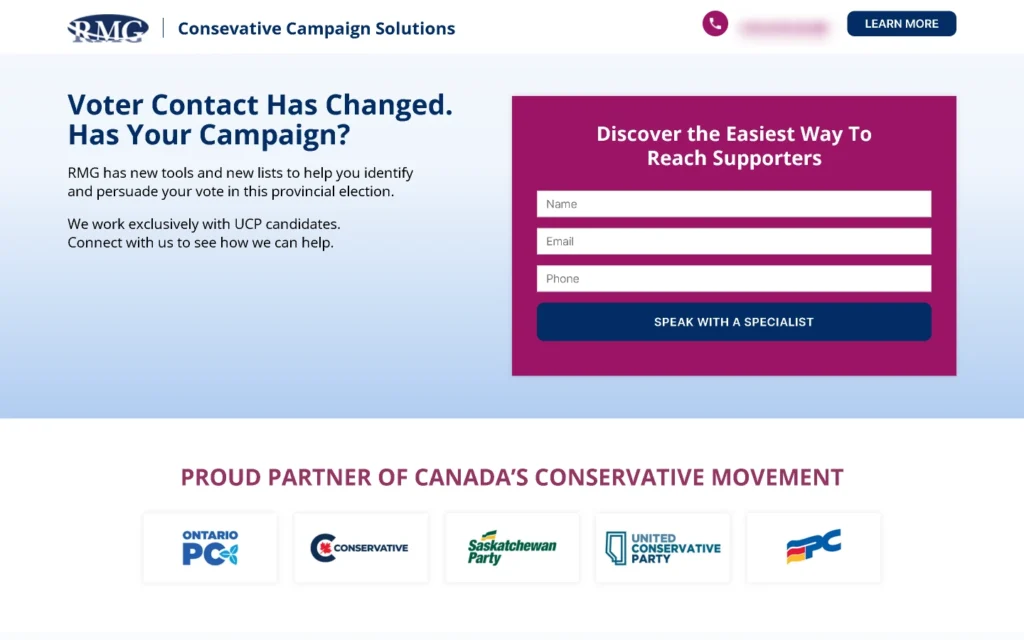
Also yes, I blurred out their phone number, they don’t need any free promo.
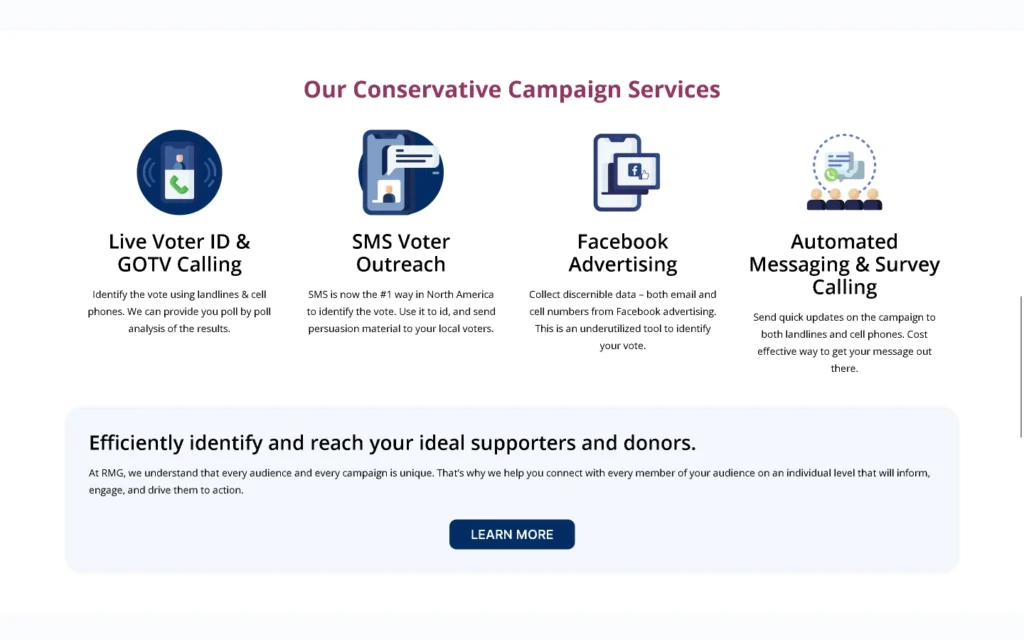
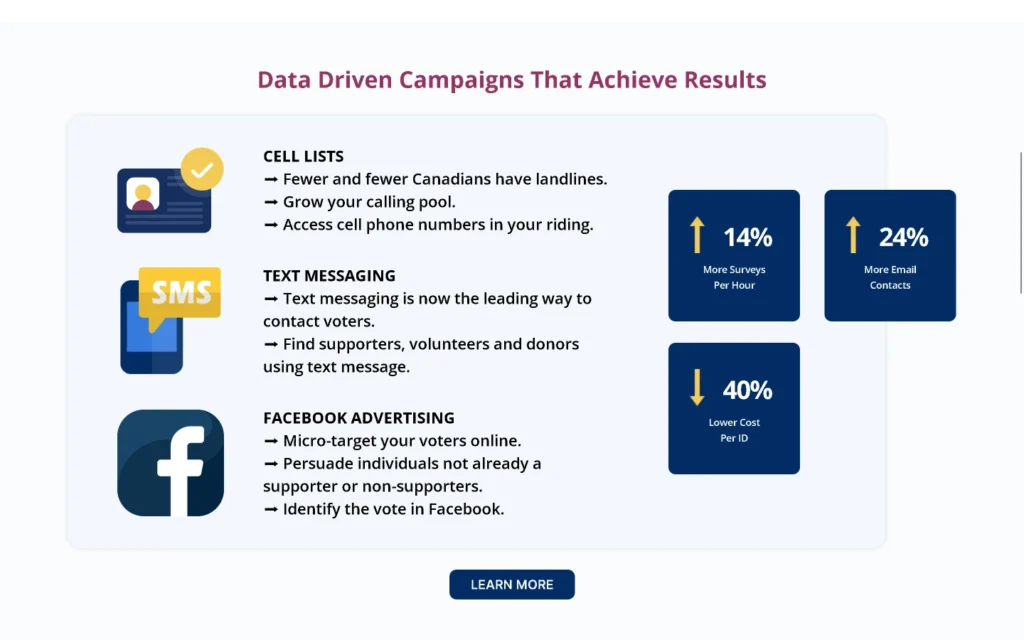
While it’s impossible to conclusively prove (from where I sit today) that the recent mass robo-texts purportedly sent by the Canada Growth Council, by the PC Party of Manitoba proper, and/or by the “Civic Progress Network” were all in fact executed by The iMarketing Group, evidence of such a relationship might reasonably be expected to exist, were this to be the case.
- The most likely evidence of such arrangements would be any extant correspondence between executives at either the Canada Growth Council or the PC Party of Manitoba with representatives of the Responsive Marketing Group, and/or with other “The iMarketing Group” entities.
- An (admittedly weak) “proof” of a potential connection between parties may be found in how the (VoIP) telephone numbers used to send the CGC and PC Party of MB robo-texts share a common carrier in “Iris Technologies” (Iristel).
- Iristel is a private company and an independent ‘Competitive Local Exchange Carrier’ (CLEC). They offer white-labelled solutions for various IT services, including “A2P Messaging“.
- Robotext campaigns paid for by Conservative parties and executed by the Responsive Marketing Group have previously been associated to phone numbers registered to Iristel.
- I haven’t actually seen any of the phone numbers alleged to have been used by the Civic Progress Network, so I couldn’t tell you if the same is true of those numbers too.
The way I see it, two possibilities exist: either the purported senders of these three recent robo-text campaigns did partner with Responsive Marketing Group to handle the actual, technical execution of robo-texts, or they did not. If these parties did partner with RMG, then that relationship warrants scrutiny in its own right; if they did not, then one is left to wonder “why not, and who else?“
3) Manitoba StWrong
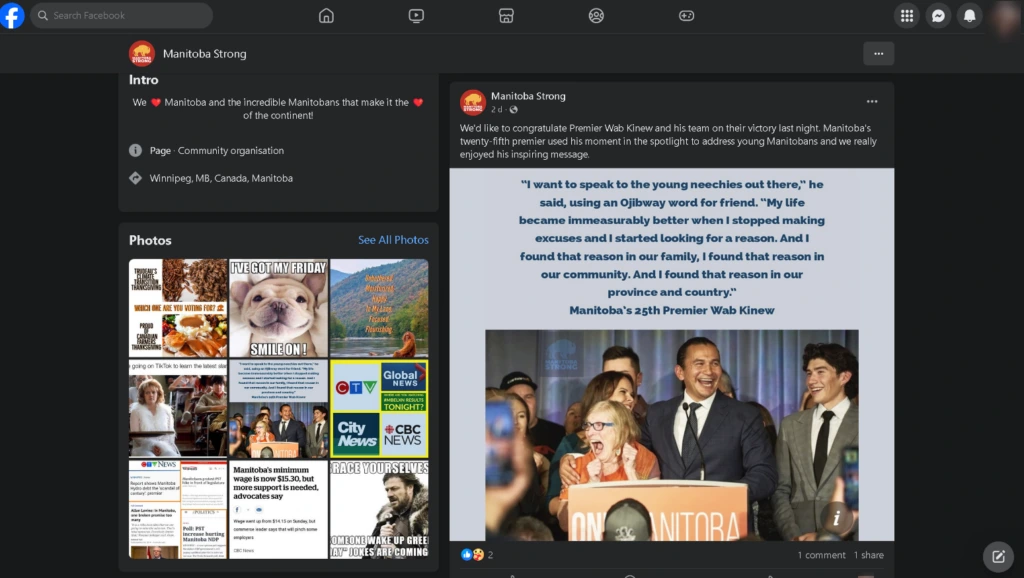
“Manitoba Strong” is a Facebook Page created on 6 April 2022; it presumedly operates as part of the larger “Canada Strong and Proud” network, which is — let’s not mince words — a Manning Centre funded front group, committed to “redpilling the Libs” (as of September 15th, Canada Strong and Proud has also registered as a third-party advertiser with Elections Manitoba).
For a long time, I’ve toyed with the idea of writing a post specifically about this particular tactic, prevailingly (but not exclusively) favoured by right-wing influence operators. In hindsight, I’m glad that I never got around to it, because everything I might have said can be summed up by sharing the following pair of real-world examples, both taken from Manitoba Strong’s recent output.
Firstly, we have the only known instance of “Manitoba Strong” ever publishing any (paid) SIEP ad via Meta Ads; the post and its accompanying video started running on or about Election Day. In a single day, Manitoba Strong’s administrators threw ~$2,000CAD into serving that ad, targeting its delivery to users in the cities of Winnipeg, Dauphin and Brandon. The following is a quotation of the text overlays which accompany the final two minutes (or so) of that video ad. Even without the benefit of reading every preambulatory text overlay, or seeing the emotionally-charged visuals, or hearing the video’s soundtrack (suitable as background music to the “spooky level” of a Sega Genesis-era platformer), it stands as a remarkable specimen of whataboutism in its own right:
Are [Wab Kinew’s] attempts to keep his actions hidden from voters a concern to you? What happened to our commitment as a society to #believeallwomen and to being allies that fight for the safety of First Nations women and minorities? So do you think Wab’s victims can be swept under the rug because he is power hungry? Do you think Manitobans should let a convicted criminal represent our proud province to the world? Do you think a tiger can change its stripes? Do you think Wab’s victims deserve our allyship and support? Are you willing to be personally responsible for electing a convicted criminal to the top job in Manitoba and normalizing breaking the law and hurting people? Can you give social permission for criminality and turn your back on Wab’s victims? Are you okay with sending the message to victims that their efforts to gain justice and have consequences attached to their pain is for nothing, when criminals can still attain the top job in the province? Are you OK sending the message to young people that they can victimize innocent people and get rewarded by society? If we’ve given up on believing victims, given up on fighting for justice and supporting Indigenous and minority victims, maybe it’s actually us that have changed our stripes.
Authorized by Canada Strong and Proud. Don’t forget to like and share this video, and make sure to follow us so you won’t miss a thing.
— Manitoba Strong, via Meta Ads, Oct. 3, 2023, as archived in the Meta Ads Library
The second example comes from Manitoba Strong’s public-facing Facebook Page. It features a selection of the Page’s recent image posts, but more importantly, the public post published at 8:40pm local time, less than 24 hours after the preceding attack ad was launched, and shortly after Wab Kinew became Premier-Elect of Manitoba:
Where To From Here?
“Speak not to me of blasphemy, man, I’d strike the Sun if it insulted me! Look ye, Starbuck: all visible objects are but as pasteboard masks. Some inscrutable yet reasoning thing puts forth the moulding of their features. The White Whale tasks me; he heaps me. Yet he is but a mask. It is the thing behind the mask I chiefly hate. The malignant thing that has plagued and frightened man since time began. The thing that mauls and mutilates our race; not killing us outright, but letting us live on, with half a heart and half a lung.”
— Moby Dick, Directed by John Huston, screenplay by Ray Bradbury and John Huston, Warner Brothers, 1956
Many hands have worked, and will yet work, to chronicle the omnishambolic meltdown of the Manitoba PCs in the general election of 2023. I could go on, but I won’t: whatever further critique I might offer would serve only to give sanctuary to scoundrels. I have no vested interest in helping the parties involved to learn from their mistakes, nor to improve upon their methods in future.
What was to be shown, nevertheless, has been shown:
- That throughout the regulated election period (and for some time prior to it), the Progressive Conservative Party of Manitoba, and/or various third parties acting to its benefit, engaged in sustained, complementary partisan advertising efforts, for which at least one key objective – given the tenor of the content of these campaigns – was seemingly to suppress voter turnouts in the 2023 Manitoba general election, particularly within certain key “battleground” regions such as suburban Winnipeg.
- That having largely “kept their powder dry” until the final weeks of the election, the Manitoba PCs marshaled all their considerable resources to do little else than broadcast dog-whistles (a stratagem at once moronic and oxymoronic), in the hopes of exacerbating known divisions among the electorate on what were, and remain – at the very least – matters of individual conscience.
- That in doing so, these “campaigning Tories” obliterated months worth of “governing Tories” talking points and public commentary as to the guiding principles and values of the Manitoba PCs under new party leader Heather Stefanson.
- That this seismic, systemic shift in tone was handled so ineptly as to insult the intelligence of its audience. Those who were not so discouraged by the conduct of their campaign as to not bother voting at all, seem likely to have been incensed to the point of casting votes in protest, out of spite.
- That for all their many, formidable advantages in both cash and capabilities, the PC Party of Manitoba proved to be a party of political Pakleds. Their ship
iswas the Heather; it is broken . - It should be acknowledged that the MB NDP’s digital campaign showed some capacity for dynamism in the final month of the race — a significant, if not decisive, factor.
- That the Manitoba electorate is not constituted primarily of hate-fueled racists and assorted other xenophobes. Were this the case, the PCs’ strategy might have paid off, irrespective of their many glaring ineptitudes.
More broadly, the general conduct of “political advertising” in the lead-up to this latest provincial election can be seen to have gone far beyond what we Canadians are apt to dismiss through the thought-terminating cliché of “American-style politics”. It is my considered professional opinion that the strategies advanced and the tactics employed throughout this most recent Manitoba election represent something altogether novel in the history of this province’s politics — novel, and profoundly corrosive to our democracy.
This was entirely by design. Sweeping changes to Manitoba’s election financing laws in 2017 limited the scope of “pre-election advertising” to only those which run within four months of Election Day, rather than at any point in the calendar year that precedes Election Day. Those changes made efforts like the Canada Growth Council’s springtime attack ad blitz on suburban Winnipeg viable. At the same time, the spending limit for third-party advertisers was quintupled.
Subsequent revisions, made in 2021, cut the duration of the pre-election “blackout period” on government advertising by thirty days. It may come as no great surprise to learn that the Manitoba Government spent far in excess of what it usually does on “political” ads, targeted especially to certain key segments of the public, during this (newly permissible) timeframe in the lead-up to the 2023 election.
What will this province’s next election cycle look like? This too is largely a “design question” — though now it is the prerogative of Manitoba’s New Democrats to define its parameters. As should be stupidly obvious, to preserve this status quo does little to foster civic engagement in Manitoba. Yet even reverting the relevant laws to their “pre-Pallister” state would seem inadequate as a response.
Consider: it has never been cheaper, nor more readily achievable, for any given party to publish partisan messaging (and to bring this content to the attention of their target audiences) than is now possible through the use of web-based marketing channels and modern, data-driven political marketing tactics. Why then should the prescribed limits on political ad-spending be increased from the limits set in an era when print, TV and radio (all of them relatively more costly as advertising media) ruled the roost?
More to the point, what prevents the Manitoba Legislature from proscribing any number of the partisan public lobbying techniques we’ve seen emerge in recent years, from pervasive robo-text campaigns of nebulous origin, to certain “behavioural marketing” techniques which prove especially controversial in the context of elections? For that matter, why should Manitoba continue to lag behind other jurisdictions globally in its approach to privacy and data rights, as these apply to its private and public sectors?
There is a certain school of thought — to which I am broadly sympathetic — that our shared political vernacular is too reliant on metaphors rooted in destructive competition; wars and horse-races and such. A few of those have surely slipped into my text here, and I have yet one more to add in closing. You will forgive, I hope, this personal indulgence in the trope, but it seems appropriate insofar as the conduct of civic life becomes more readily appreciable through the lens of “information warfare”, with our screens and devices as “attack surfaces”, and public sentiment as “the battle-space”:
Aqaba is over there; it’s only a matter of going.
The ongoing, debilitating idiocy of those who would oppose it is no sound basis for building a shared vision of a better future. Something more is required. Fortunately, in these respects at least, this is a thing now wholly within the power of Manitoba’s new government to realise.
