
“At a time when free and fair elections are a concern in democracies around the world,
we need to be vigilant when it comes to ours being undermined.”— Kelvin Goertzen, 23rd Premier of Manitoba, 23 August 2019
You’d be forgiven for assuming that when Goertzen uttered these words — then serving as Manitoba’s education minister, and currently as its Minister of Justice and Attorney General — he was addressing any number of topical issues, then bubbling into the public consciousness.
Was he referring to Russia’s alleged (and largely substantiated) attempts to interfere in the 2016 United States elections, a great many of which are purportedly bankrolled by (the late) Yevgeny Prigozhin?
Did the Minister’s comments betray some insight into the (alleged) efforts by the Chinese Communist Party to (allegedly) interfere in the Canada’s 2019 federal election, efforts that were (allegedly) actively underway at the time of Goertzen’s speech?
Or perhaps he was alluding to the activities of Cambridge Analytica, and the bombshell revelations made by company insiders Christopher Wylie and Brittany Kaiser? Just one month earlier, Netflix had released The Great Hack, a glitzy-but-good documentary on the role of emergent “microtargeting” tactics in the U.K.’s ‘Vote Leave’ referendum campaign, and in Trump’s 2016 US presidential run. That certainly would have thrust the topic front-and-centre in the minds of at least some provincial voters.
The real answer, as it turns out, was D: none of the above. The quote comes to us from a press conference, arranged by the governing Tories during the 2019 Manitoba general election, at which Minister Goertzen announced that his party had lodged a formal complaint to the provincial elections commissioner. The Tories were alleging that Unifor — a trade union registered as a third-party political advertiser with Elections Manitoba — had spent over $25,000 (the limit then imposed by provincial election financing law) to purchase “at least seven billboards”, each one bearing the same message: “Don’t let Pallister wreck health care”.
“It’s not just the rental time that they’re there,” Goertzen said from the dais, pleading his party’s case to the assembled press, “but it’s also the production and the installation costs”. Goertzen insisted that the billboards ought to be taken down straightaway, and that no other penalty envisaged by The Elections Financing Act would be sufficient. “If they are exceeding the limit,” he said, “it can really have an impact on elections. And the ability to solve that and to have a recourse for that is simply a fine after… votes may have already been influenced.”
For their part, Unifor’s regional director called the complaint “desperate” and “a laughable distraction”; the union later filed its expense reports, as all third-parties are obligated to do, which showed costs of about $19,000 for its electoral advertising during that election period. About a year later, Manitoba’s Commissioner of Elections quietly dismissed the PC Party’s complaint.
That was then; this is…wow.
In the first of this (planned) trio of posts on the Manitoba 2023 election, I described at length the recent $50,000 Meta Ads campaign (nevermind the robo-calls and mailers) paid for by the “Canada Growth Council” to deliver partisan ads attacking Manitoba NDP leader Wab Kinew (plus a handful of other sitting NDP MLAs) to voters in most of Winnipeg throughout May and early June of this year. I also expressed some skepticism as to the Premier’s (and her party’s) knee-jerk denials of having any hand in, or knowledge of, the CGC’s planned activities in Manitoba.
(As a brief coda to that post, subsequent reporting by PressProgress’ Emily Leedham would seem to have borne out many of my suspicions on these fronts. Canada Growth Council did ultimately register as a third-party in Manitoba (as is required of all advertisers with over $2500 in “election communication expenses” in the “pre-election period”), but ever since the start of the formal “pre-election period”, their “Manitoba Watch 2023” account has fallen silent. See you next time, fellas!
For this second installment, my original plan was to give an update on the “state-of-play” when it comes to (online) political advertising by Manitoba’s main political parties. I had planned to draft and publish that update shortly after the “pre-election period” had ended, and the formal writ of election had been dropped.
But then…well. The plain truth is, over this summer and prior to the writ-drop, none of the registered parties have done anything — at least nothing much worth blogging about, and certainly not worth reading any blogs about. Also, I got burned out of my apartment in mid-August, so that wound up adding another week or two to my (arbitrary and personal) publication deadline.
Oh, sure, I probably could have made things easier on myself. Maybe punched out a few hundred words about something weird and small, like the case of Efficiency Manitoba, the Crown corporation which has apparently trafficked and flighted more than a hundred unique ad creatives since the start of June. Or I could “make hay” over the somewhat baffling decision, by both the Manitoba NDP and Manitoba NDP Caucus, to exclude Facebook and/or Instagram users who show an interest in “agricultural machinery” from seeing most of their political ads. But I’m honestly not sure how long I could go on writing on that topic before it took on the quality of having something whispered at you, through gritted teeth, by someone stood three inches from your face, unblinking.
…But hey, while we’re here: say Dippers, how does that old song go again, eh? Come on something, soldier, some-or-other, from the mine and factory?
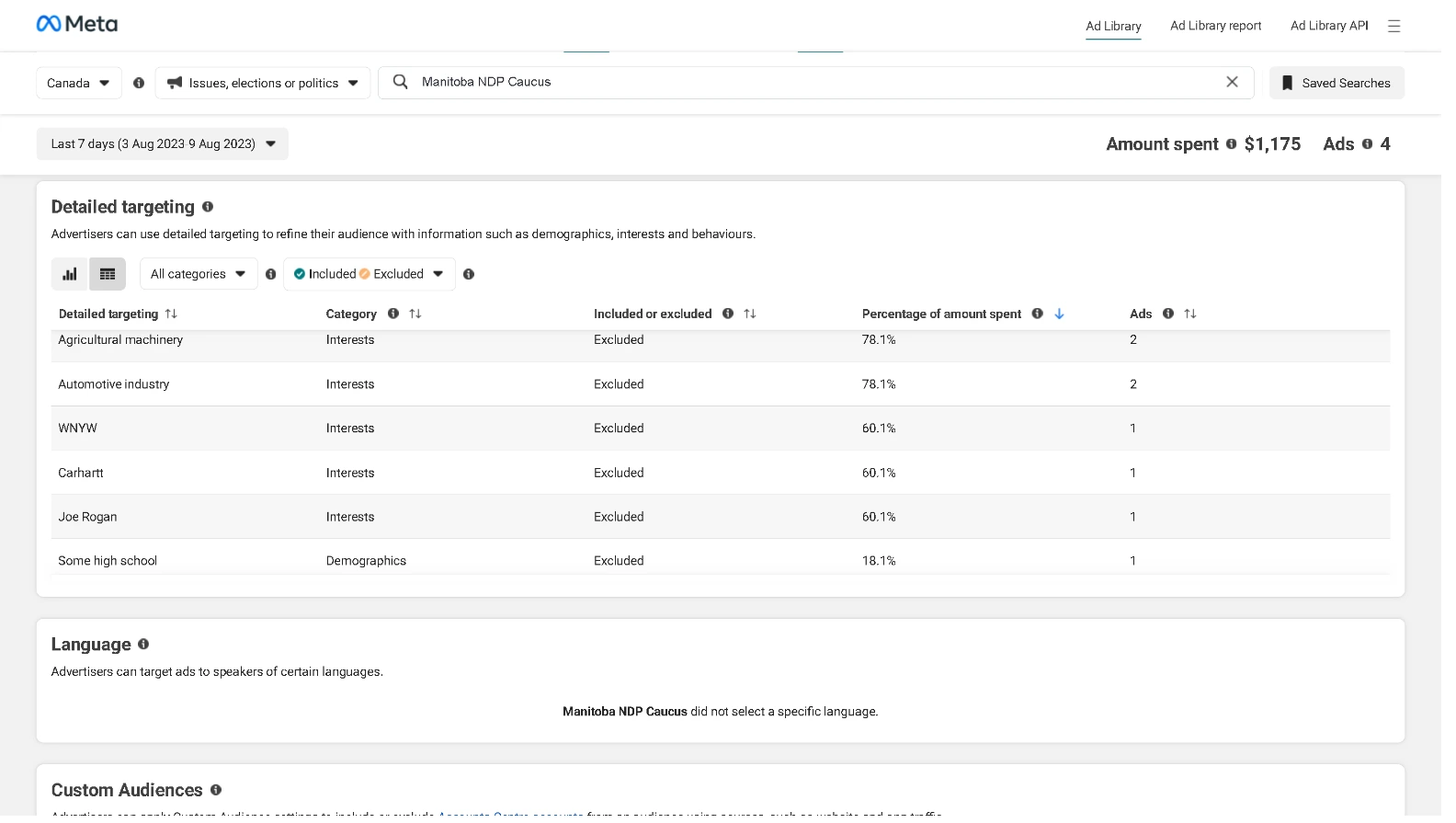
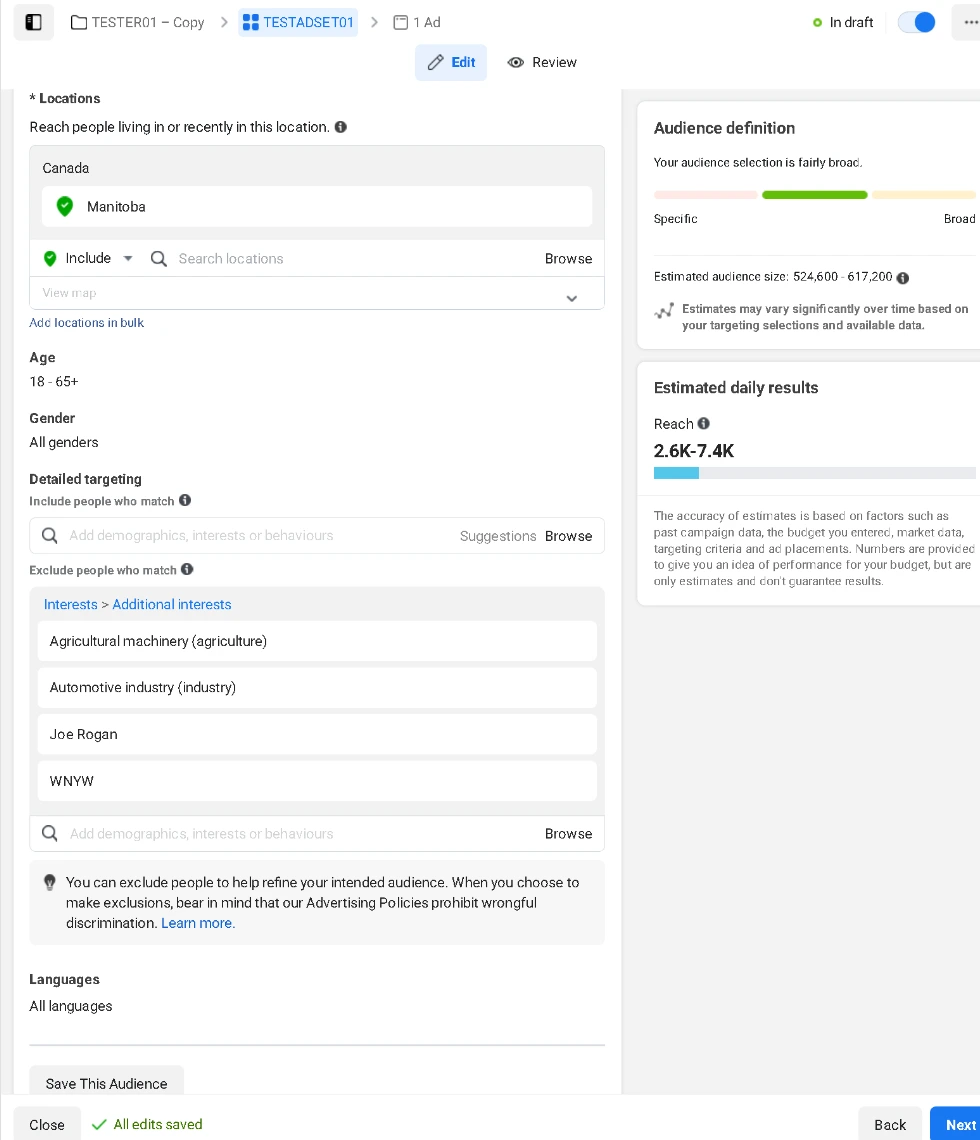
No, even with those cases, I’d still only be talking about a few hundreds, maybe thousands of dollars in dubious political ad-spend — small potatoes, in the grand scheme of things. If this middle installment is to offer any meaningful insight and/or clues as to how the 2023 Manitoba election might play out, then we’re going to need to talk about…
The 800-Pound Bison in the Room
According to the Meta Ad Library report, no single advertiser spent more in the first third of Manitoba’s formal “pre-election period”, targeting users located in Manitoba with what Meta deems “ads about social issues, elections or politics”, than the Government of Manitoba itself. The extent to which the Manitoba Government dominates the overall “universe” of political advertising (via Meta Ads) in the province was — in a word — remarkable.
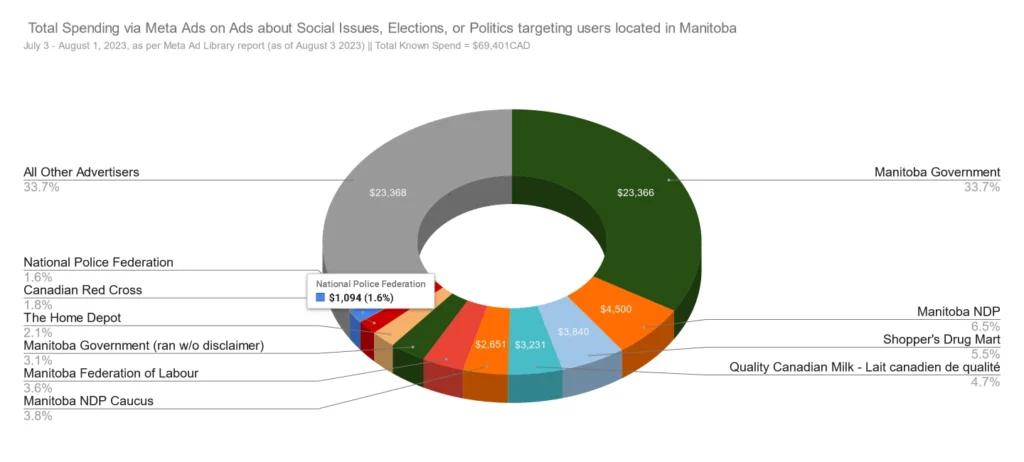
There are, I am certain, plenty of strange and noteworthy insights one might glean by poring over the full history of Meta’s Ad Library archive for the Manitoba Government’s official Facebook account. But in doing so, one would quickly run up against perhaps the greatest limitation of ‘user-friendly’ interface provided by Meta for accessing their Ad Library: they do a downright lousy job of surfacing insights on the overall activities of a given partisan advertiser, for any timeframe other than:
- The past 7 days
- The past 30 days
- The past 90 days
- All time (in Canada, since approx. Q3 2019)
This largely precludes one from using the basic Meta Ad Library UI to do things like, say, compare how the Manitoba Government’s “political” advertising in the lead-up to the 2023 ‘election blackout’ period might differ from the approach and/or tactics applied to such campaigns in the past. To pull off a thing like that, one would have to go through a much more onerous process of verifying their identity to Meta, in order to gain access to the ‘Meta Ad Library API’, so they could make (and then “clean“) all of the queries required to pull a complete dataset on every “political” ad to ever run via the Government of Manitoba’s official Meta account since 2020. And even after you had managed all of that, just to make all that data intelligible, you’d still probably want to build out some sort of reporting engine to turn all that data into charts and visualisations.
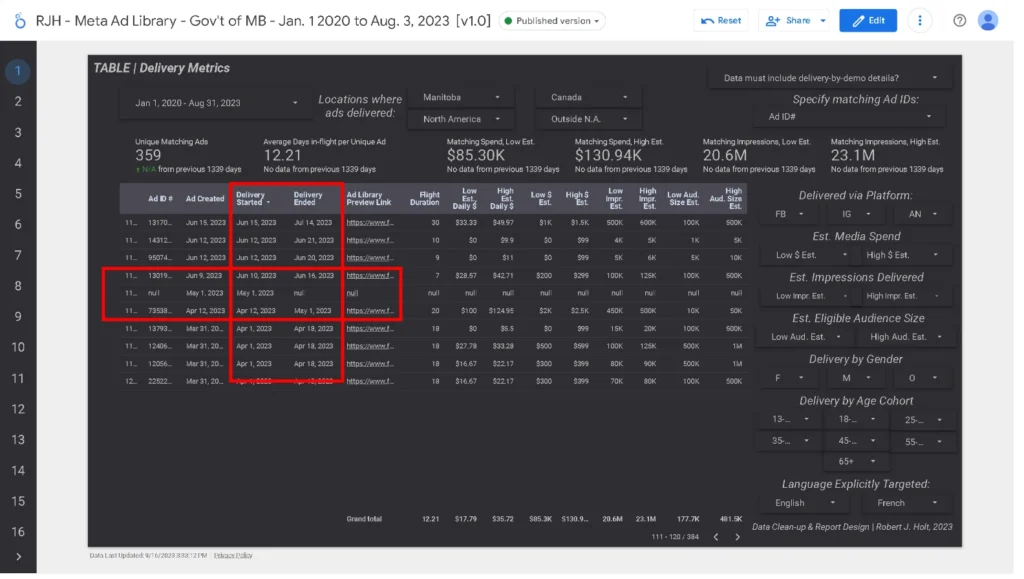
Anyways, I recently went through the somewhat onerous process of verifying my identity to Meta, so that I could make calls to the Ad Library API, to pull (and then clean) a complete dataset on (almost) every “political” ad that the Government of Manitoba’s official Meta account has run during the lifetime of its 42nd Legislature. Then, to make all that data intelligible, I whipped up a custom reporting engine to spit out some charts. You can access it here. Feel free to play around!
To save you the trouble of clicking your own way through it, I have compiled a few of the more salient conclusions I’ve drawn, after sitting with the reports (and the underlying dataset) over the past few weeks of design & development. To wit:
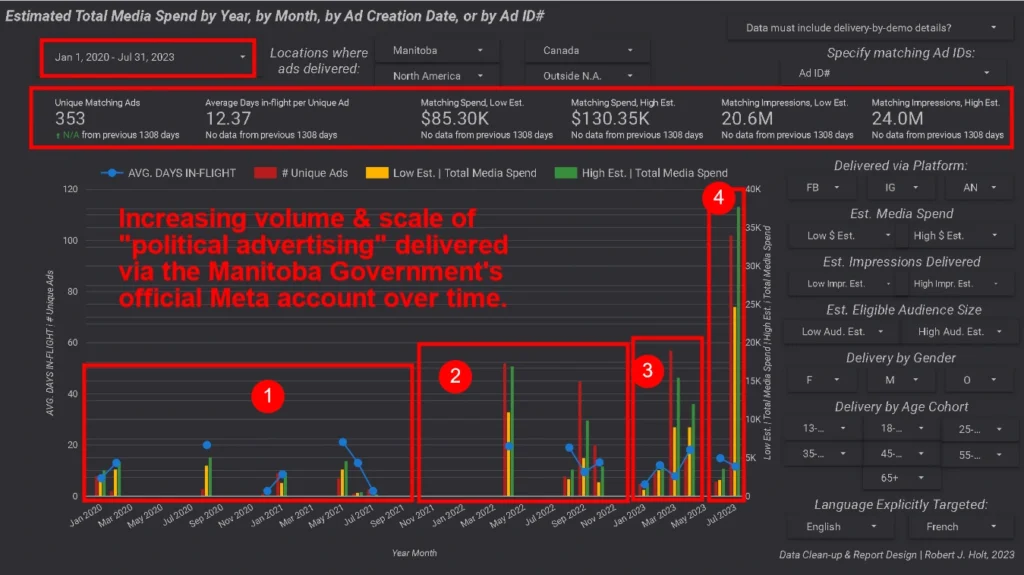
“Epochs” of Manitoba Government political advertising via Meta Ads during the 42nd Legislature
First things first: it is often useful, for analytical purposes, to distinguish between periods (or “epochs”) based on some shared traits and/or qualities of the data at a given point in time. With regard to “political” ad campaigns by the official Meta account(s) of the Manitoba Government, I came to adopt the following system of classification:
- These earliest “political ads” (for which Meta Ads Library data is available via the API) were “in-flight” circa December 2019
- For ease of comprehension, records from any ads created before Jan. 1, 2020 have been filtered/excluded from the “scorecards” found on all pages of the “reporting engine” described/linked above, and shown in the screens below
- “Epoch I” spans from the earliest federal/provincial public health measures in response to COVID-19, to the earliest federal approvals for COVID-19 vaccines
- Epoch end-date coincides with Heather Stefanson’s victory in the PC leadership race (Oct. 30, 2021) and her being sworn in as Premier (Nov. 2, 2021)
- Several observed changes in the strategy/tactics applied to “political” advertising, compared to the preceding period
- Epoch end-date chosen to reflect several “year-end” interviews in which Premier Stefanson suggested (to paraphrase) that her greatest challenges as Premier had been issues of “communication”, but also that steps had been, and were being, taken to “fix” this:
- Manitoba Government needs to do better job of highlighting accomplishments: premier, CBC News Manitoba, Jan. 11, 2023
- ‘Moving in the right direction’: Premier Heather Stefanson defends her government’s record on health care, dismisses predictions Tories headed for election defeat in wide-ranging interview with Free Press, Jan. 11, 2023
- Several observed changes in the strategy/tactics applied to “political” advertising, compared to the preceding period
- Epoch end-date chosen to reflect the start of the formal “pre-election period”
- Per Elections Manitoba, the “pre-election” period began on June 7, 2023
- Per the Meta Ad Library, all “Government of MB“ SIEP ads via Meta Ads were paused from May 1–June 10. Pin this in the back of your mind; I’ll return to it
- Still further significant changes to the strategy/tactics applied in SIEP ads run via the Government’s official Meta account(s)
Comparing the scale, volume, and substance of political advertising by the Manitoba Government via Meta Ads during the 42nd Legislature
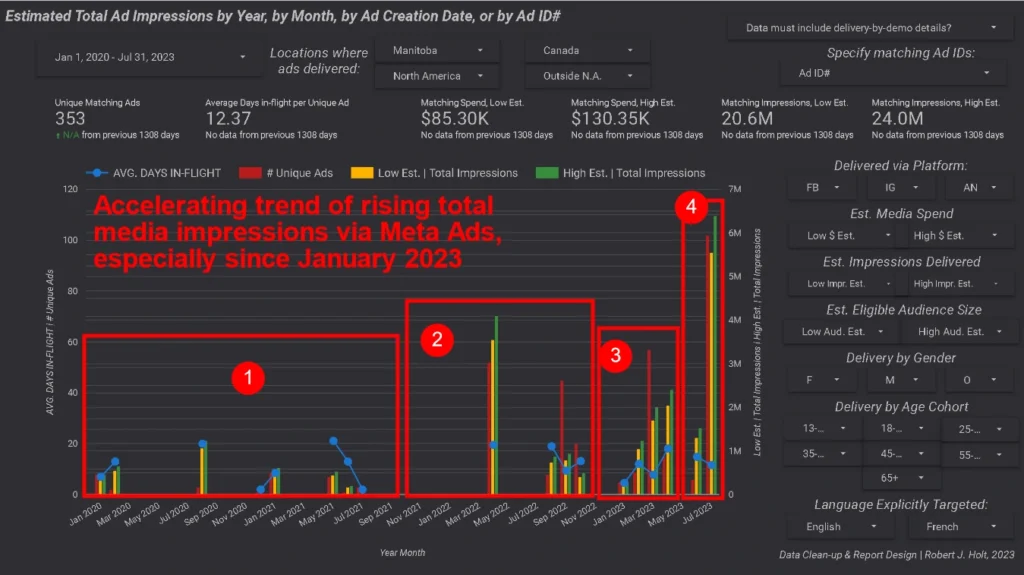
The four “epochs” outlined above will perhaps make more sense by reference to some charts produced by the ‘reporting engine’. Below are a pair of screens, presenting the total number of unique ads trafficked per month. Also shown are the cumulative low/high estimates of total spending on each of these ads (Figure 4), and the cumulative low/high estimates of total impressions served (Figure 5), per month of ad creation.
Immediately below these charts, I’ve also included a brief chronological list of “notable campaigns” during each epoch, to provide greater context as to what kinds of “political” advertising the Manitoba Government has engaged in over the course of the past three and a half years. Click the subheadings below to access those.
- ~$5,000–$7,500 spent promoting the 2020 provincial budget;
- ~$3,500–$4,500 spent promoting the Manitoba-Québec Exchange Program for French Immersion students in Grades 10 or 11;
- ~$2,000–$2,500 spent promoting “The #RestartMB Pandemic Response System“;
- ~$2,000–$2,500 spent promoting the ability of Manitobans to purchase hunting licenses, fishing licenses, and/or park vehicle permits online;
- ~$5,000–$7,500 spent promoting the 2021 provincial budget;
- ~$3,500–$4,500 promoting the “Better Education Starts Today” plan; and
- ~$500–$600 spent encouraging Manitobans to be vaccinated against COVID-19
- NOTE: I’m not aware of any pandemic-specific Meta accounts or identities the Manitoba Government may have set up to execute public advertising campaigns related specifically to the its COVID-19 response, and/or provincial efforts to vaccinate the population. What I do know is that any such campaigns were unlikely to have been run via the Meta accounts of Manitoba’s regional health authorities, considering how the WRHA has run no “SIEP” ads via Meta Ads since 2019
- ~$5,500–$9,000 spent promoting the 2022 provincial budget;
- ~$5,250–$7,750 spent promoting the availability of free COVID-19 rapid testing kits “at many retailers”;
- ~$2,250–$3,500 spent soliciting nominations for the 2022 “Empower Women Awards“;
- ~$3,250– $5,250 spent touting the “Manitoba Affordability Package”, a set of one-time cheques for $250 or more mailed to Manitoban families; and
- ~$3,500–$8,000 spent promoting a new “strategic plan for healthy and active lives for seniors”
- ~$9,000–$15,000 spent promoting the 2023 provincial budget;
- ~$2,000–$2,500 spent promoting a financial support program made available through Accessibility Manitoba;
- ~$6,600–$11,500 spent promoting the “Historic Help for Manitobans” public awareness campaign; and
- ~$9,500–$13,250 spent promoting government investments in various “community grant” programs
- ~$3,000–$5,000 spent on a public awareness campaign re: healthcare staffing, with most ads bearing the tagline “Retain, Train, Recruit”;
- ~$3,500–$5,500 spent promoting Manitoba’s Bilingual Service Centres;
- ~$3,000–$6,000 spent on public awareness campaigns, with most ads bearing the tagline “Healing Healthcare: A Recovery Plan”;
- ~$10,000–$12,000 spent promoting Government funding commitments related to education; and
- ~$500–$1,500 spent promoting a grant program which partially covers the cost of hearing aids for Manitoba seniors
Comparing the use and prevalence of ‘microtargeting’ via Meta Ads by the Manitoba Government during the 42nd Legislature
“Microtargeting” — as the very first sentence of its Wikipedia entry will tell you — “is the use of online data to tailor advertising messages to individuals, based on the identification of recipients’ personal vulnerabilities”. You’re not likely to find a better summary of the concept than that. I certainly haven’t. So let’s not reinvent the wheel!
We also need not burden ourselves with a lengthy discussion on the “shoulds” and “shouldn’ts” of using such tactics in political advertising, and/or online marketing more generally. It is [current year]; folks will approach these issues from varying perspectives, and some of them even do so in good faith. Having said that, a ready consensus might perhaps be found among Manitobans for the notion that, as a rule of thumb, the ‘microtargeting’ of public advertising campaigns (ie. those undertaken by the state, and using public funds) should be only as granular as necessary for the efficient delivery of the services or programs being promoted.
What I mean by this, to clarify, is that if the Government intended to promote, say, a program aimed exclusively at Manitoba’s seniors, then it makes sense that such advertising campaigns could and would be targeted specifically at users of Meta’s platforms who are known/inferred to be over the age of 65. But if the government program serves a more “general public” mandate, then the delivery of that message should reasonably (and roughly) correspond to the basic age and gender distribution of the (adult) population overall.
As you’ll see in the charts below, since August 2022, there has been an ongoing trend away from targeting ad creatives to broad “general audiences” (e.g. “Manitobans aged 18+”) in the range of 500k-1M Meta accounts, and towards tailoring individual creative/messaging variants to more granular subsets of Meta users (eg. Manitoba females above the age of 55). Below, Figure 6 presents a month-by-month average of low/high estimates for “eligible audience size” per unique ad.
I should also point out that the frequency with which “microtargeting” tactics are applied to (ostensibly) public ad campaigns run via the Manitoba Government’s official Meta account(s) has spiked in (the ongoing) “Epoch 4”. Some tactics, for example the targeting of certain ad creatives specifically to users known/inferred to be male, were not observed in any prior ‘epoch’ found in the Ad Library records – dating back nearly four years.
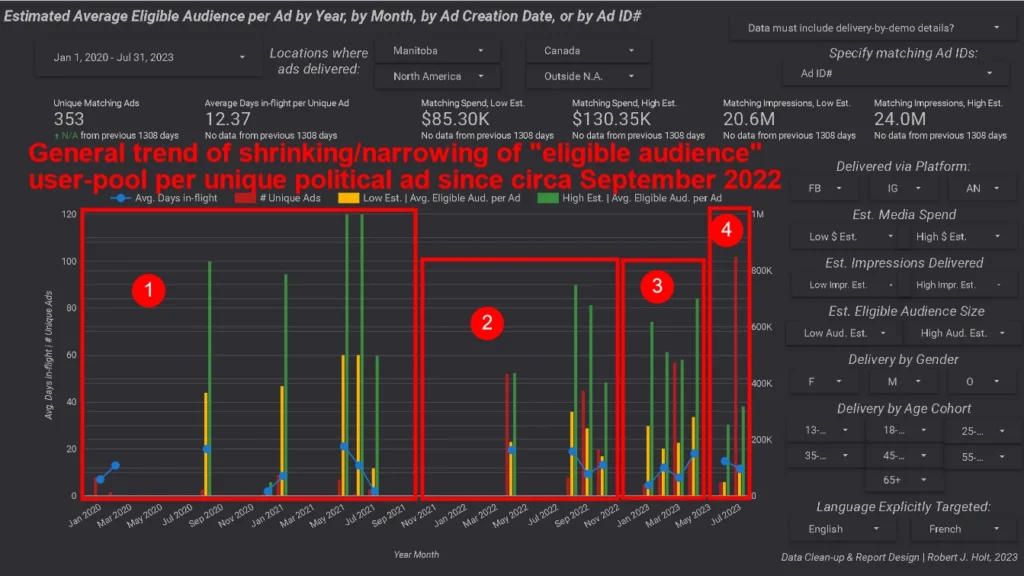
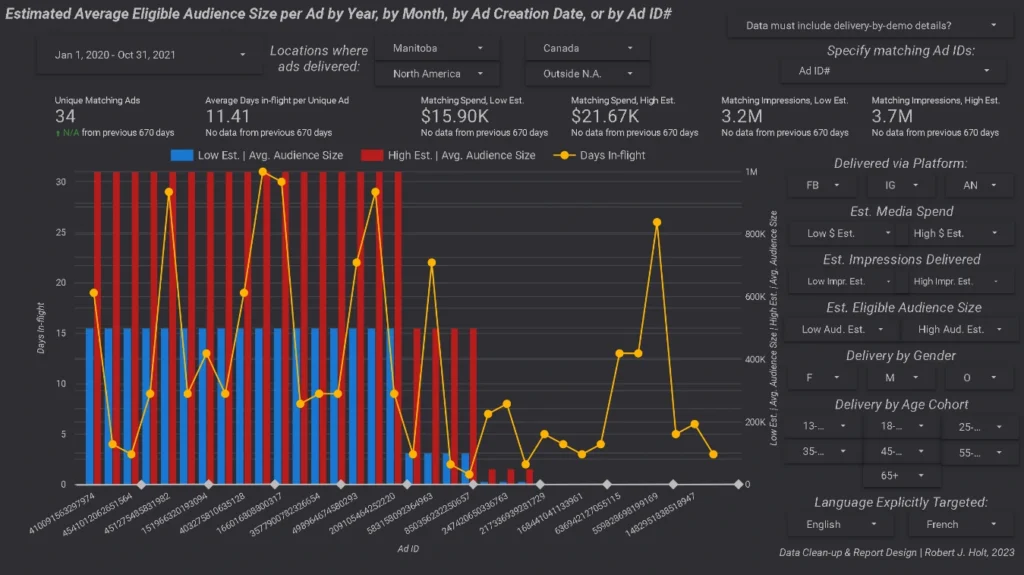
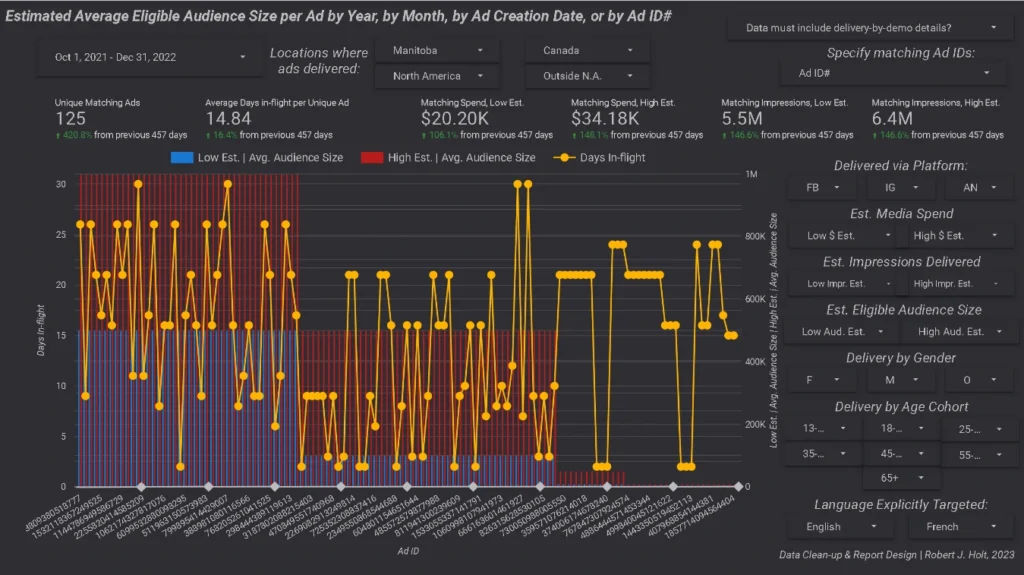
Figure 7 below depicts the eligible audience sizes of each unique “political” ad, in descending rank, per epoch. Figures 8–10 present the proportion of ad impressions served, per unique ad in each epoch, by gender cohort (Figure 8), by users aged 18-24 (Figure 9), and by users aged 65+ (Figure 10).
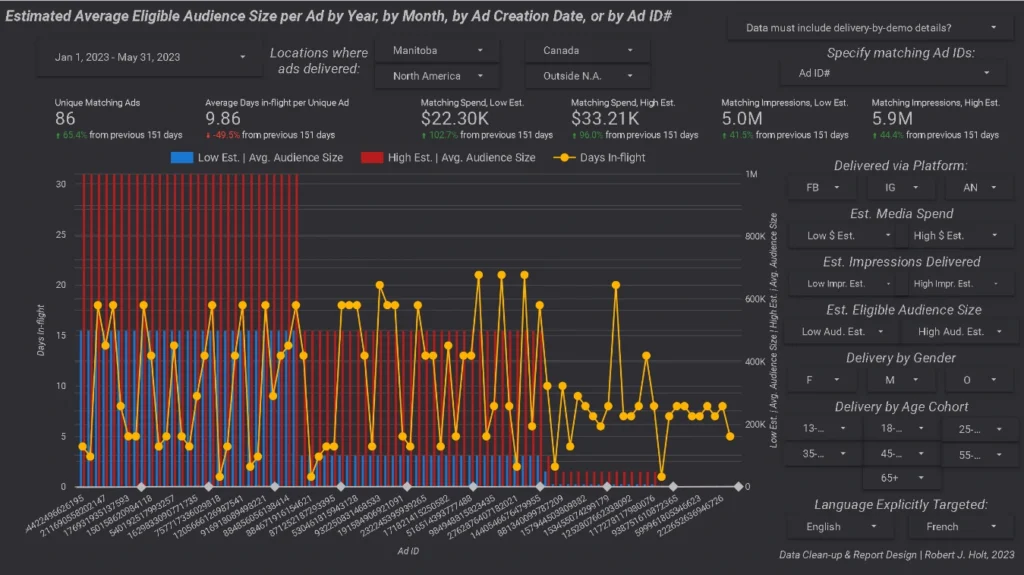
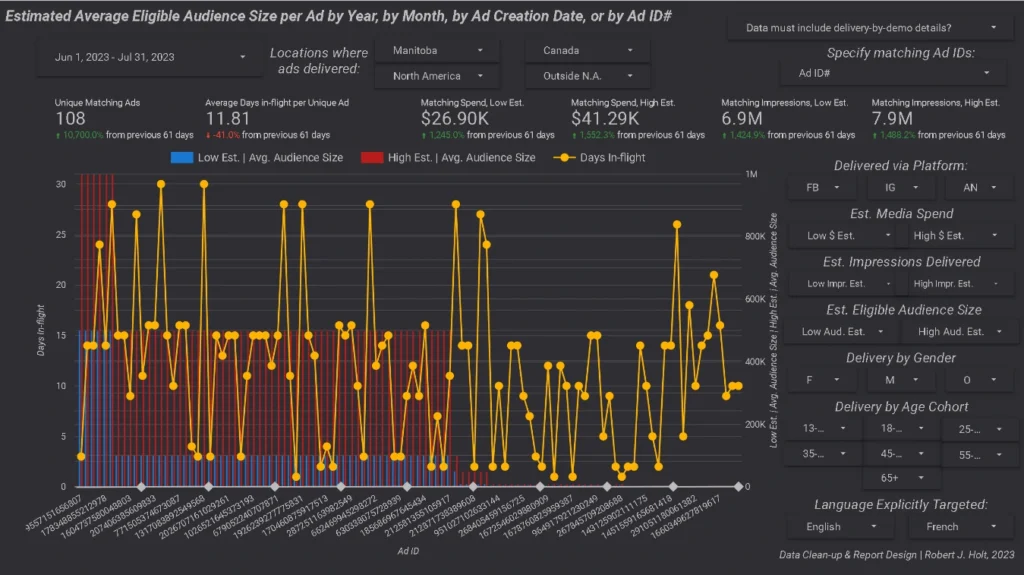
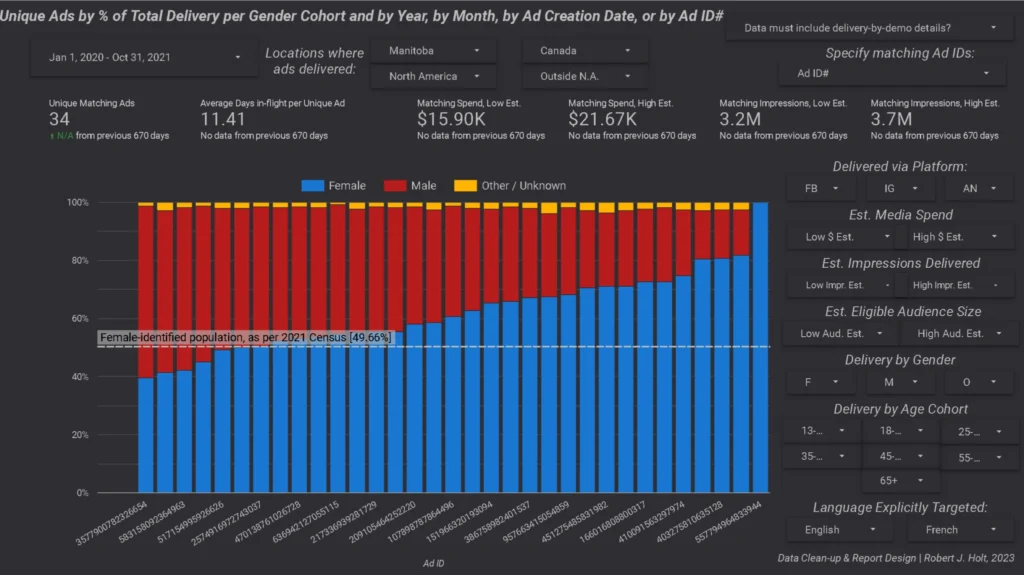
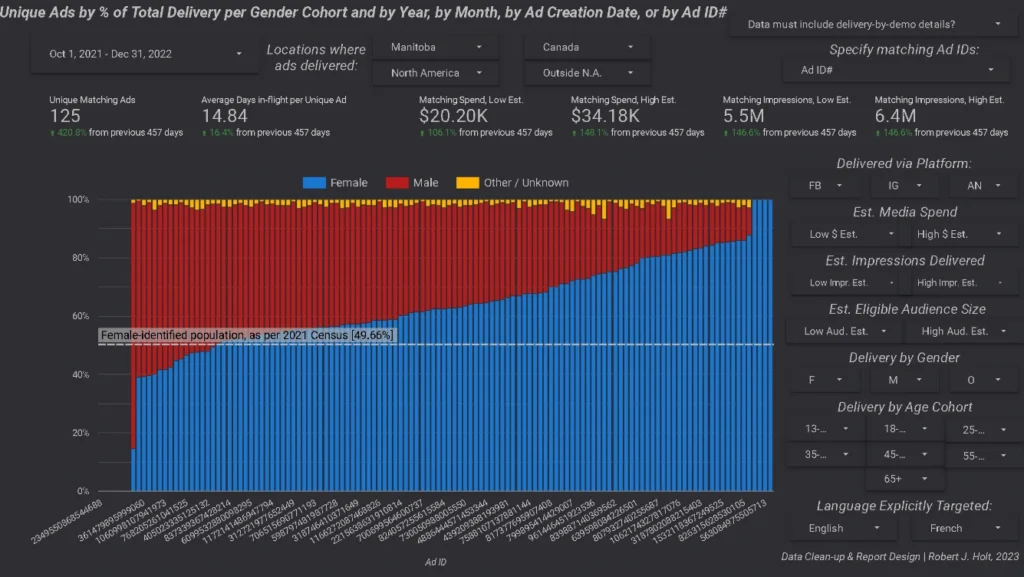
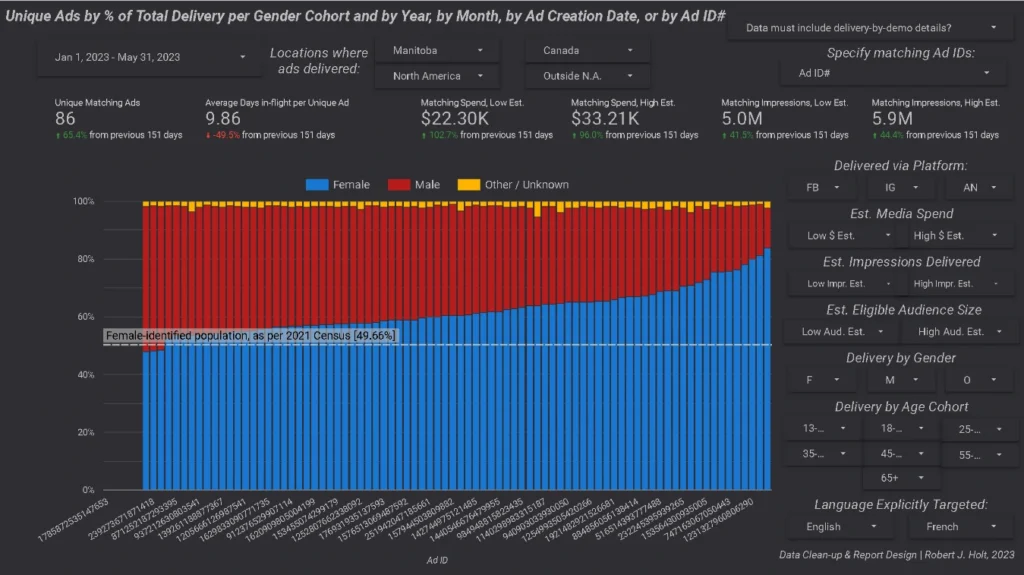
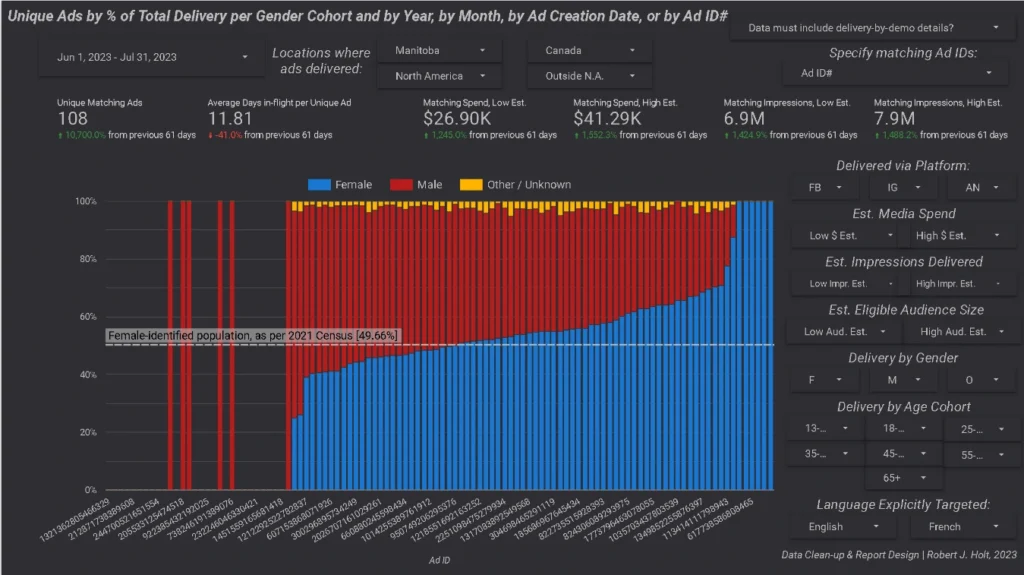
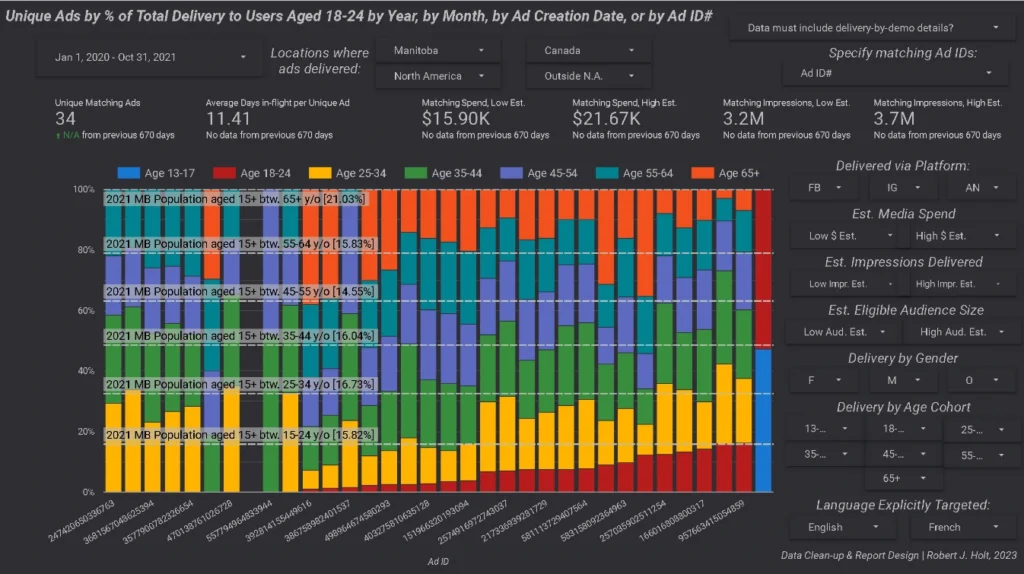
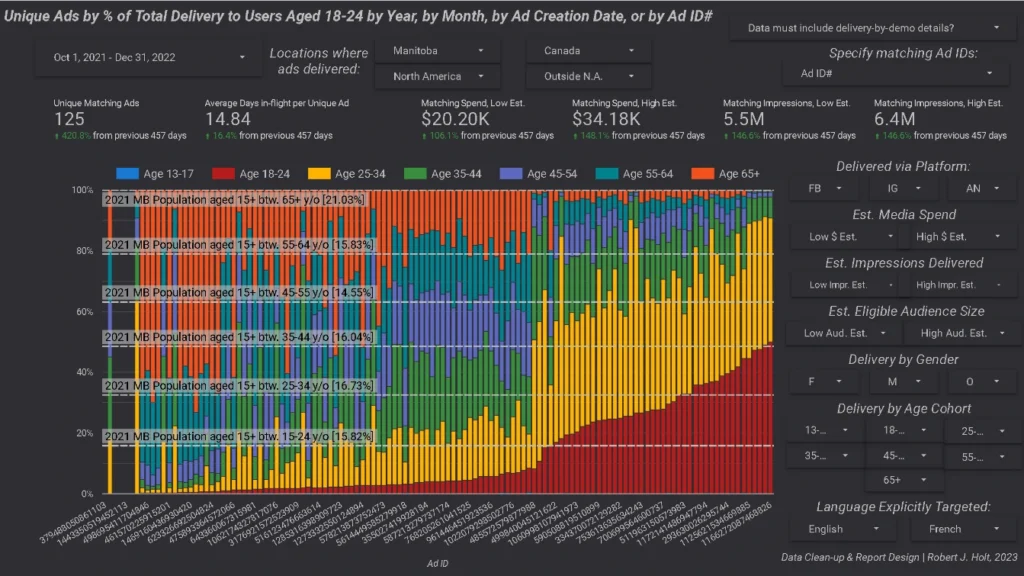
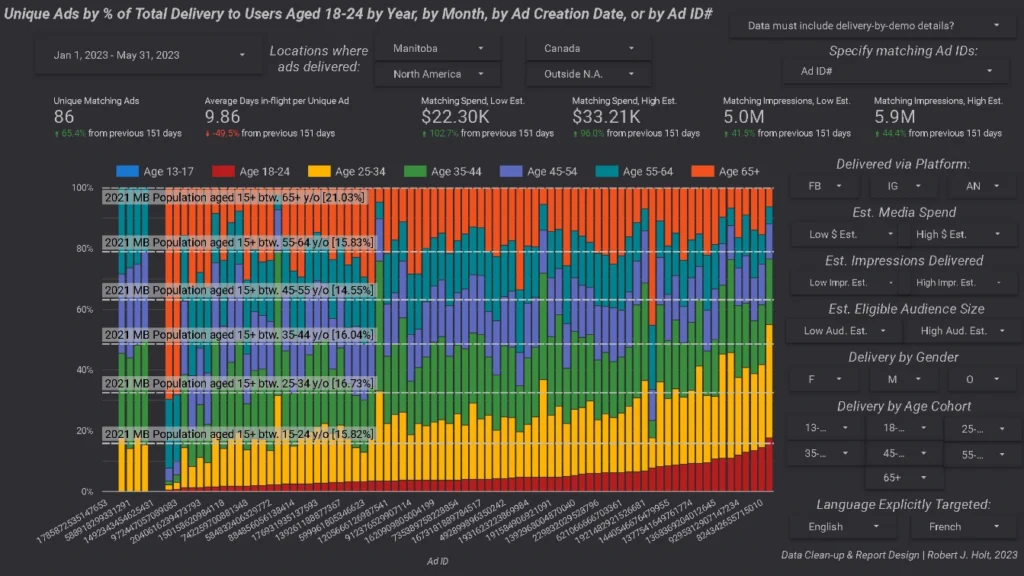
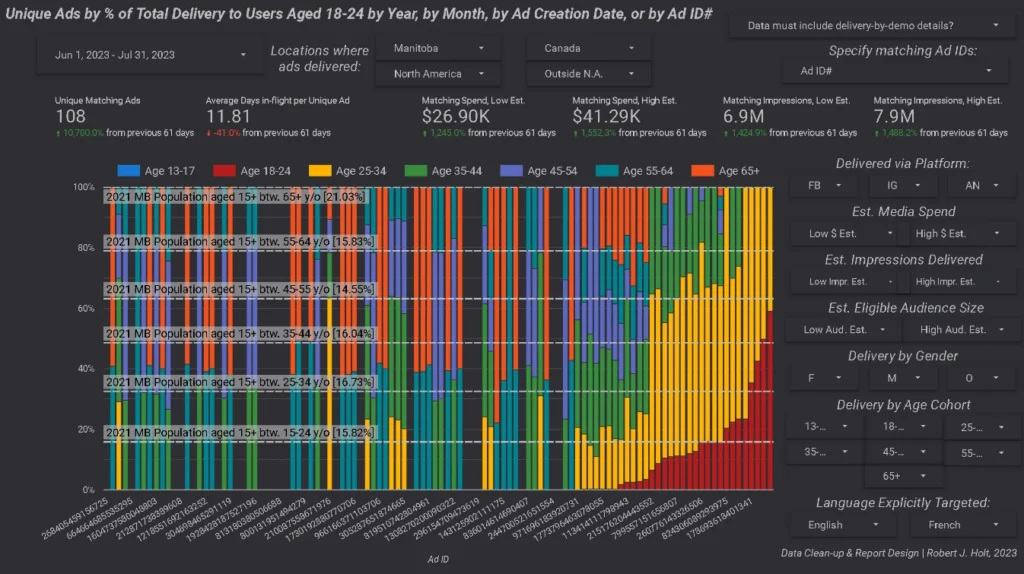
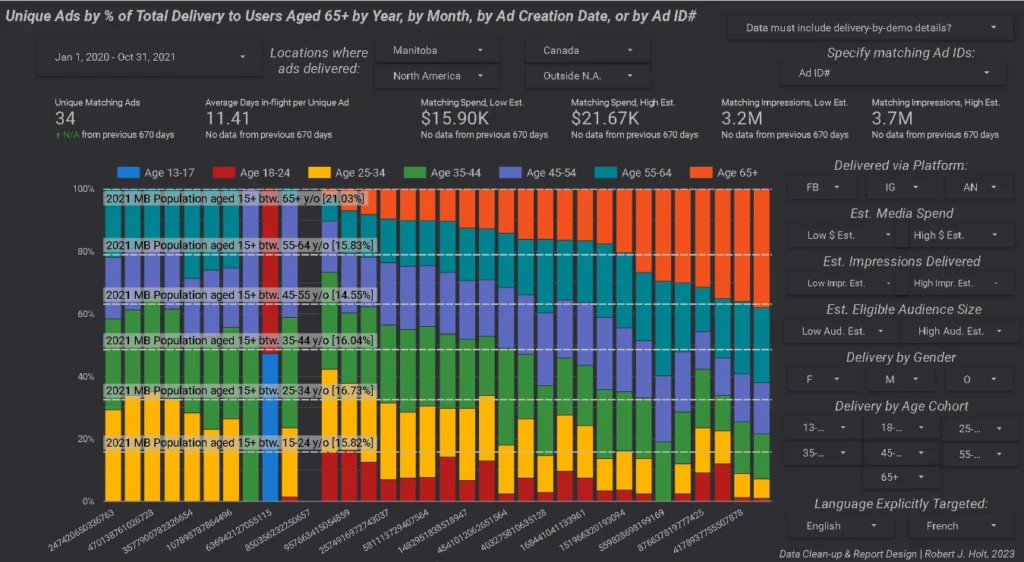
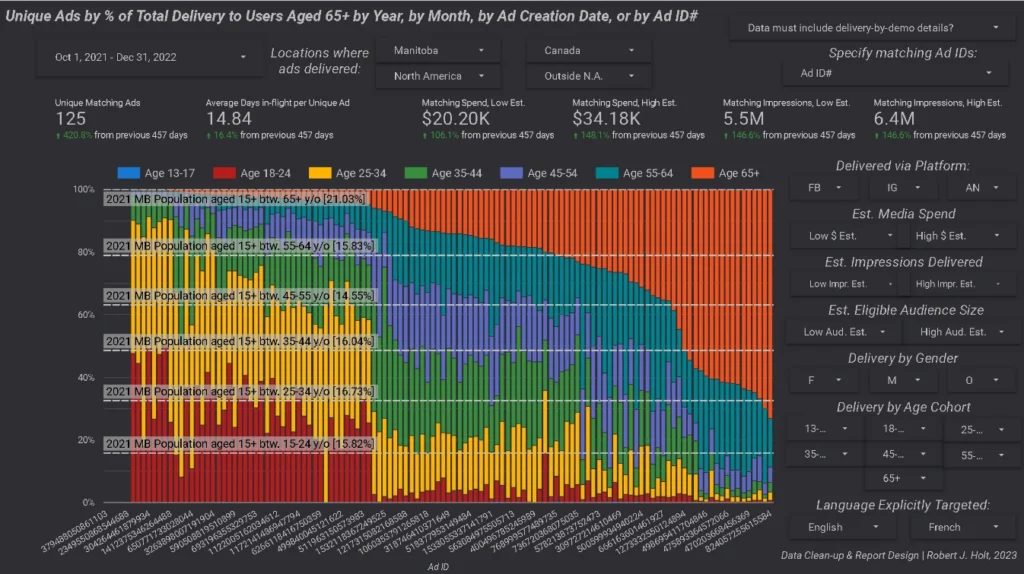
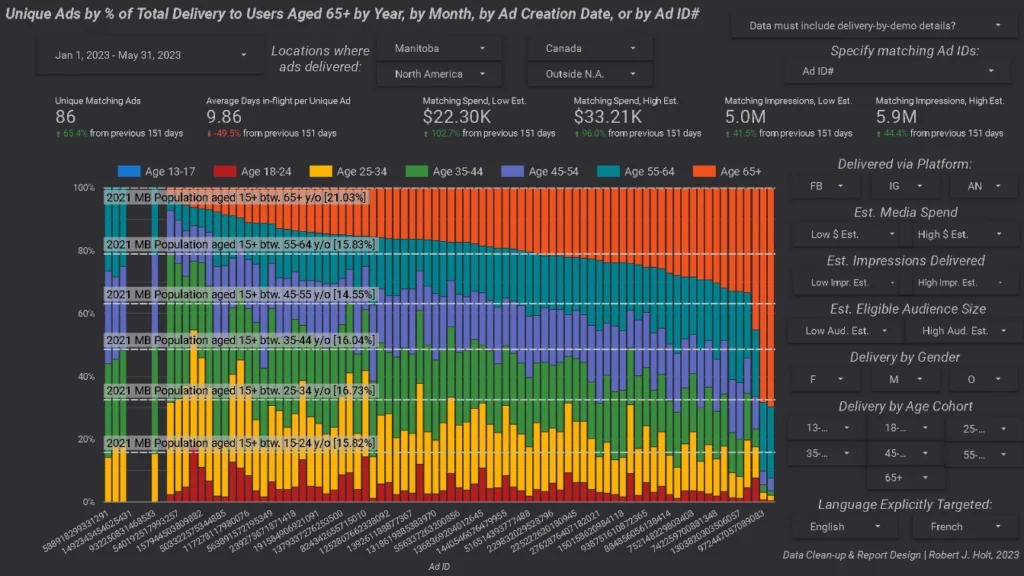
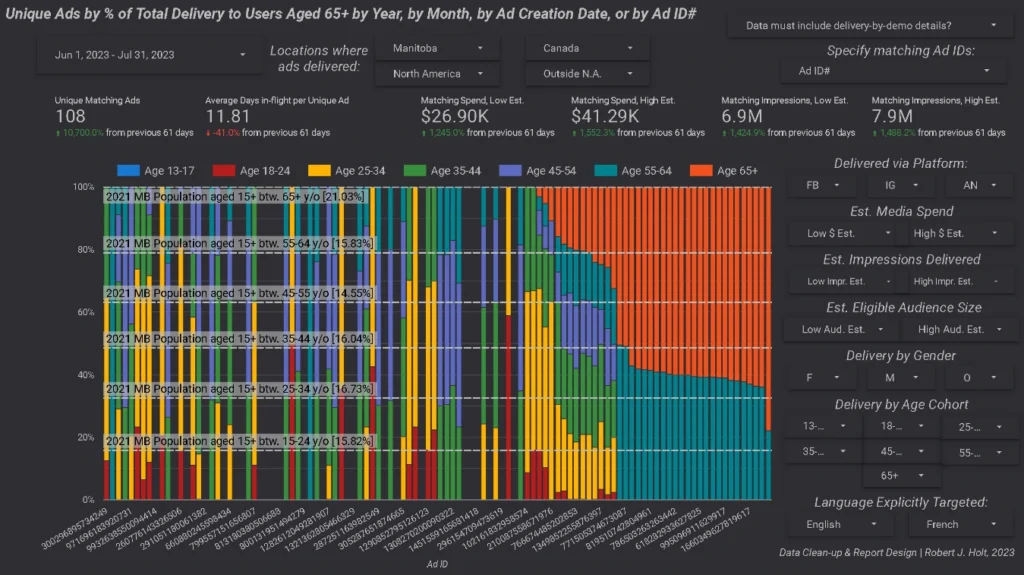
All SIEP ads run via the Manitoba Government’s official Meta account were paused throughout the Canada Growth Council’s partisan advertising campaign in May/June 2023
Posted without further comment.
Impact of microtargeting on language used in MB Gov’t SIEP ads (via Meta Ads) in 2023
Forgive me if, up until this point, this has all seemed terribly abstruse. Hopefully I have managed — at the very least — to make clear my belief that something is happening here, that it’s something Manitoba has not encountered before and that people ought to be paying attention.
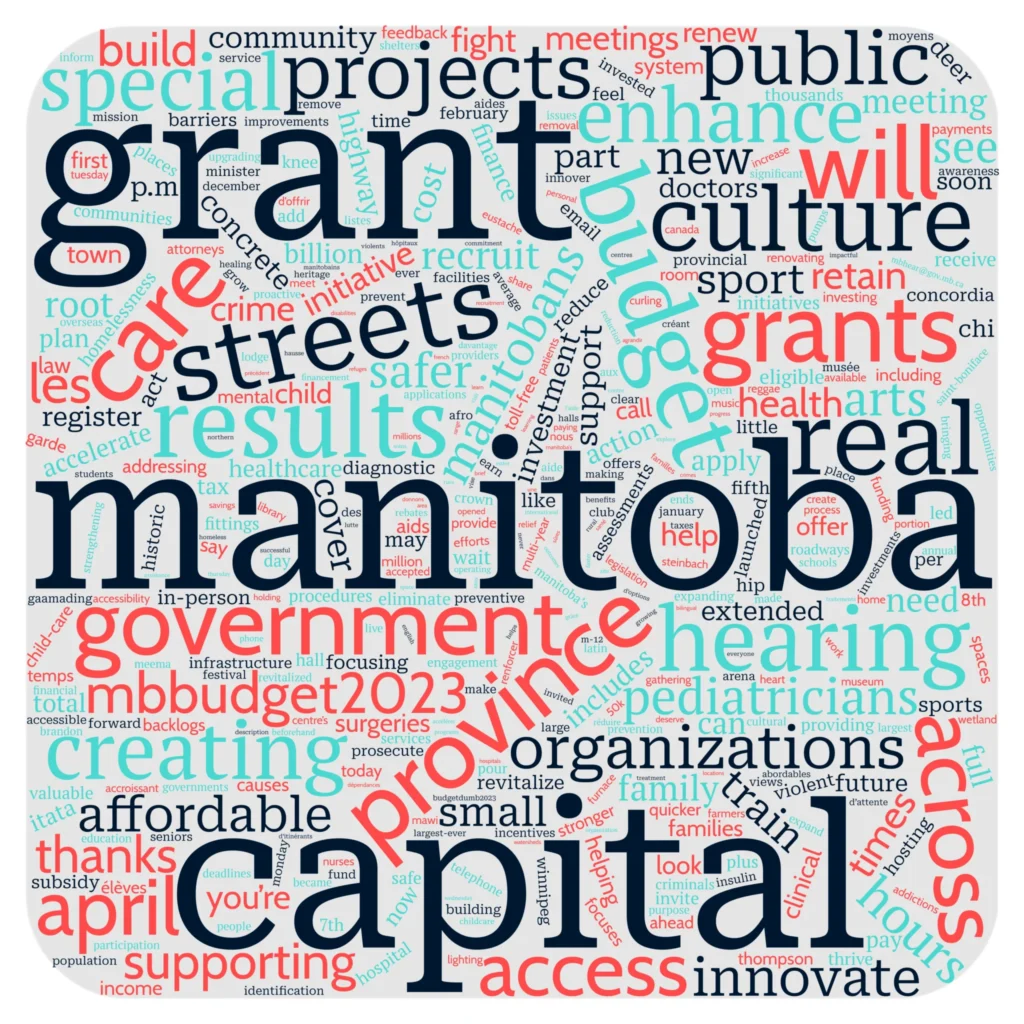
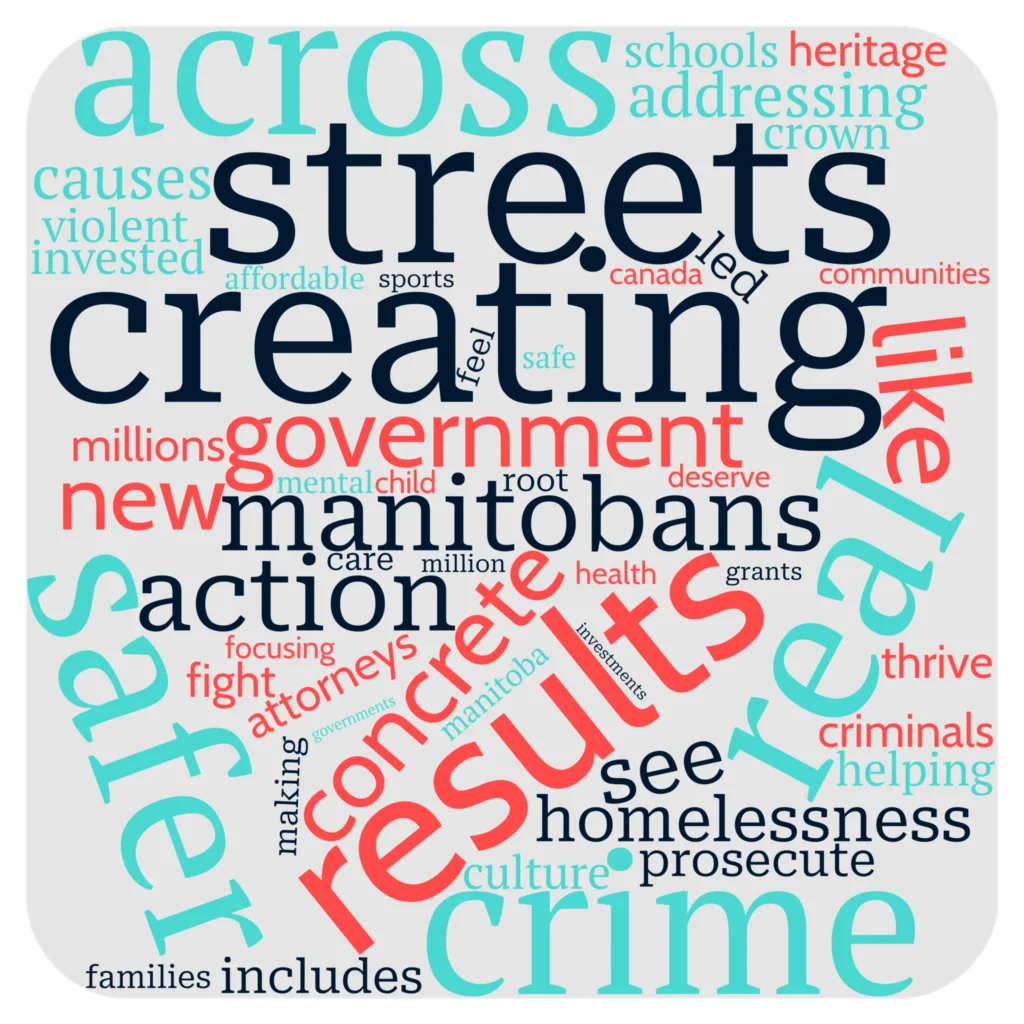
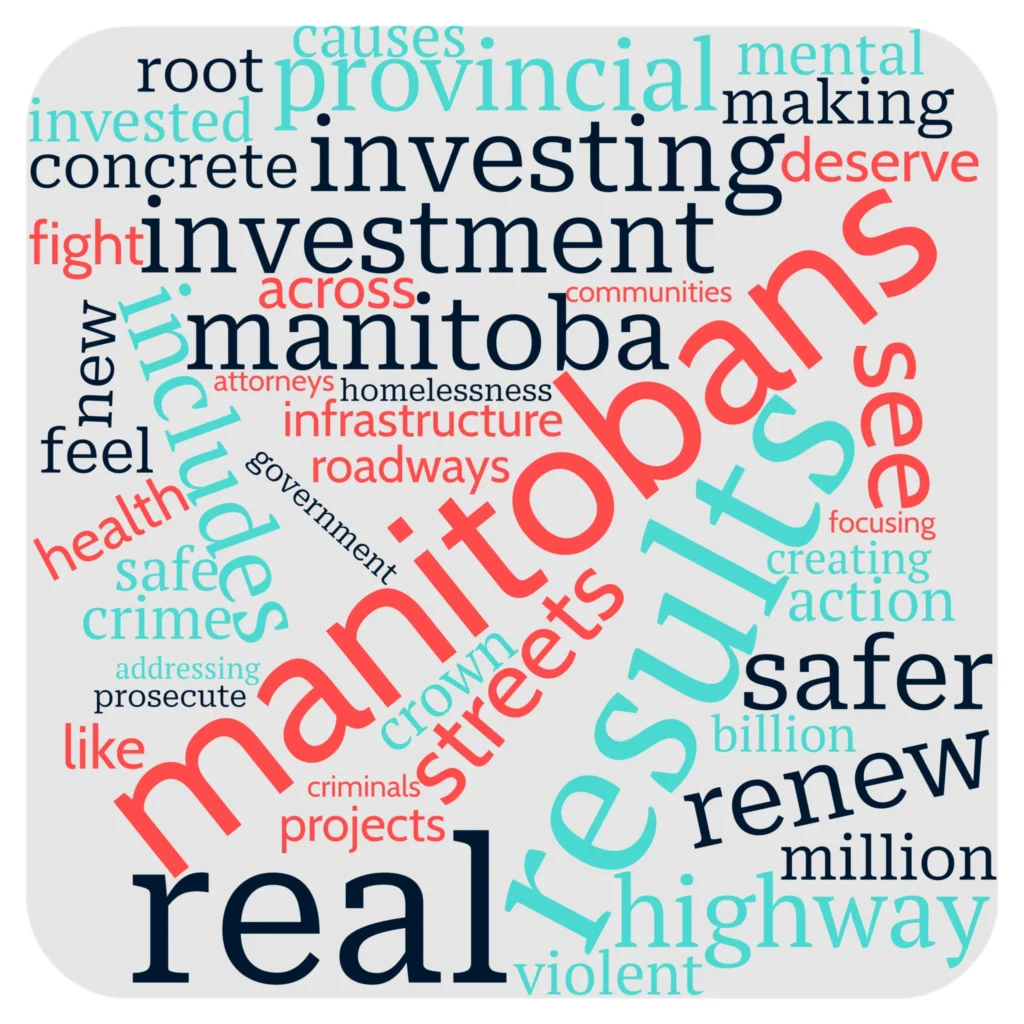
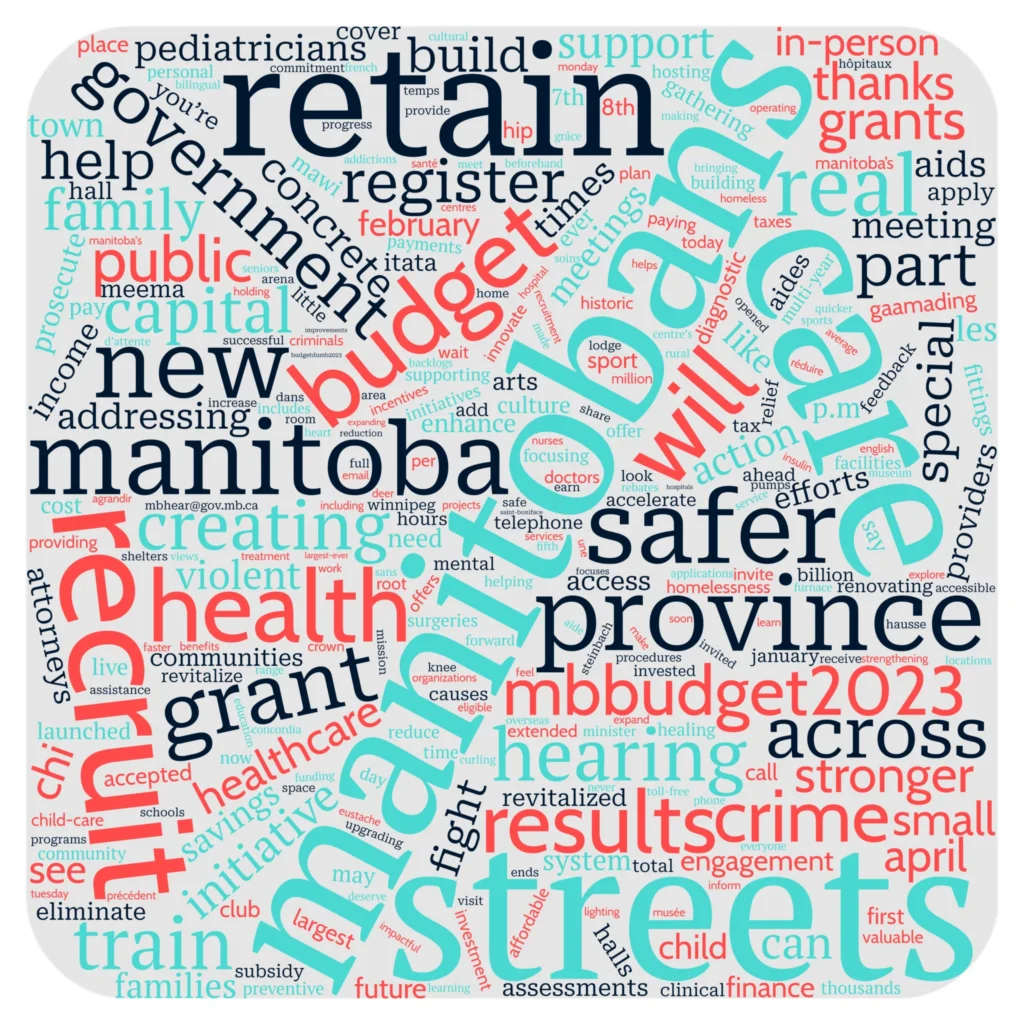
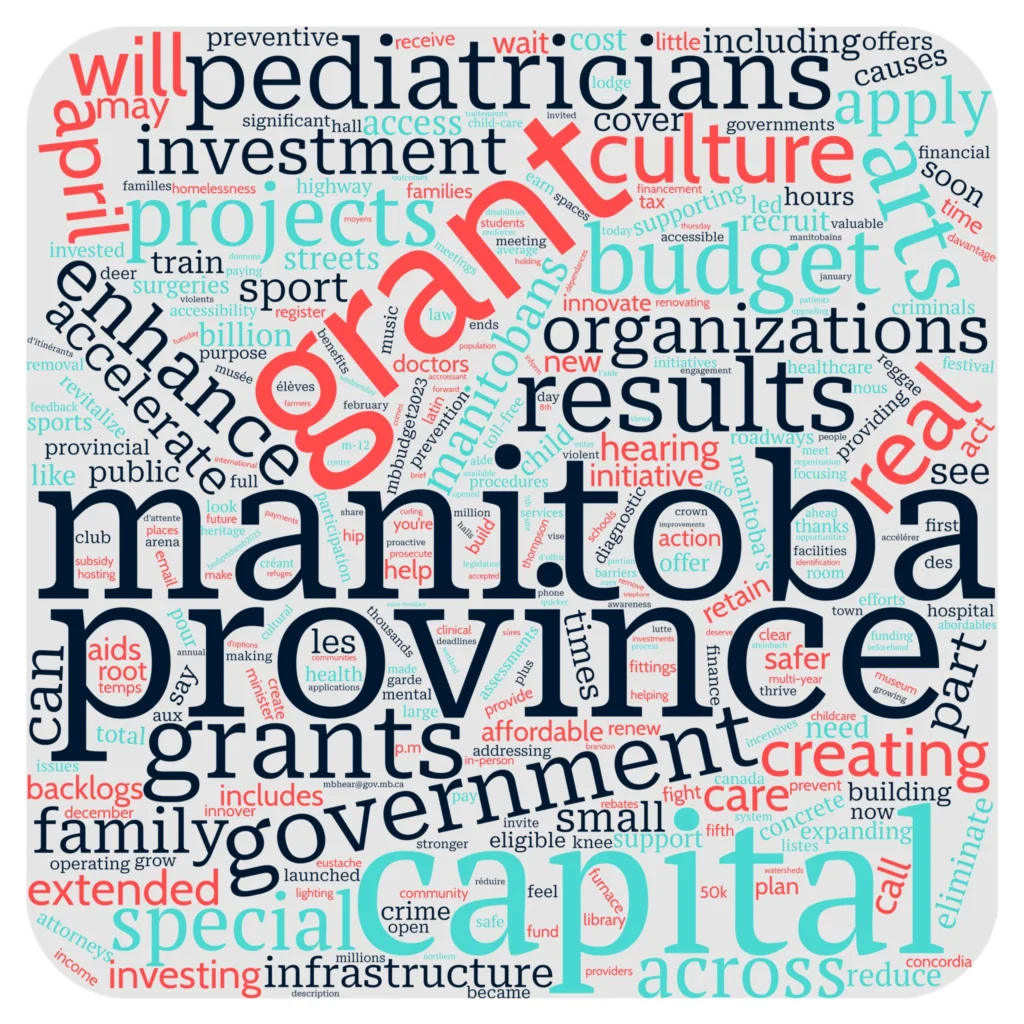
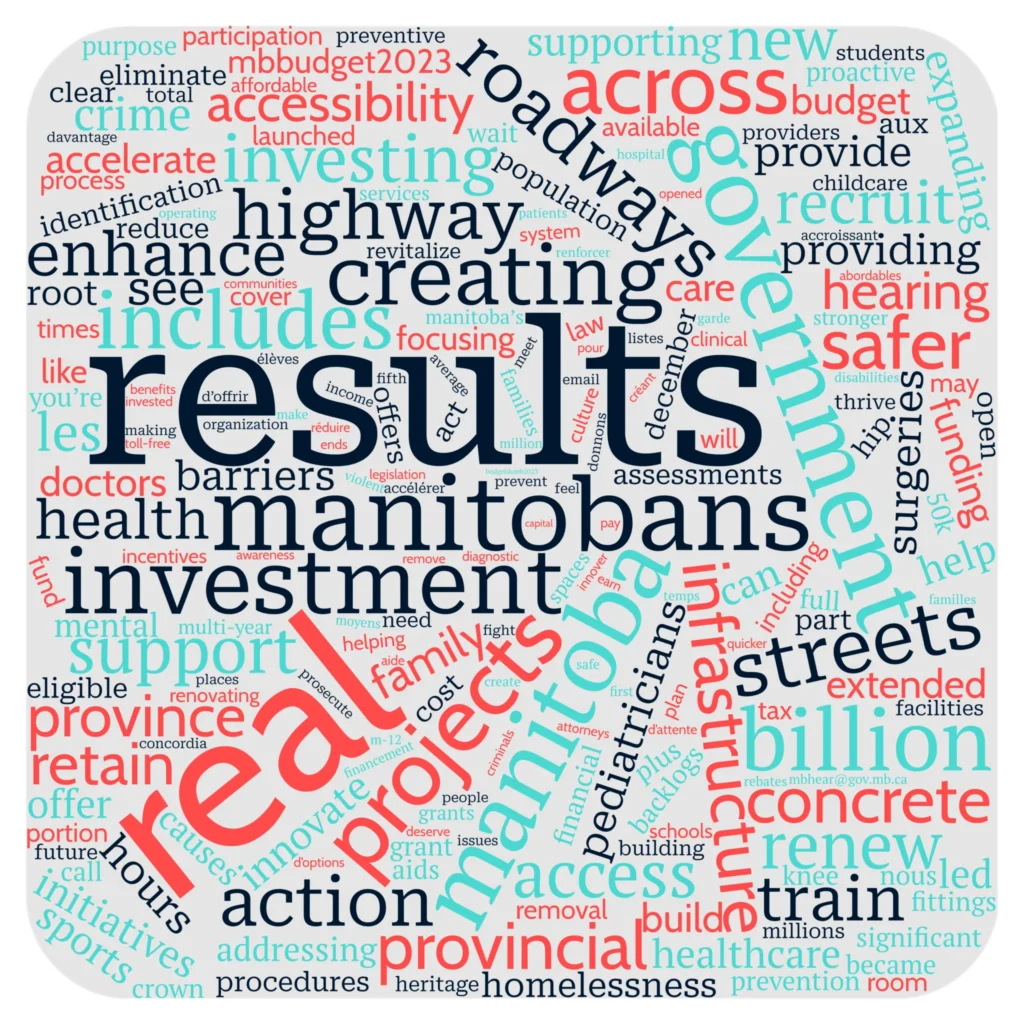
To drive these points home, I took this analysis a step further, and produced “tag clouds” based on the ad copy used in SIEP ads which ran through the Manitoba Government’s official Meta account in this year to-date. The resulting tag clouds help us better understand not just who the Government’s various ‘target audiences’ have been, but also what the Manitoba Government tends to say to these audiences most often, and how official Government messaging may vary depending on the target audience.
The first subhead below expands to show a tag-cloud of all (English-language) ads created during “Epoch III” and “Epoch IV”. The second subhead features tag clouds specific to those ads which saw their delivery “overindex” towards either male or female audiences, in order to compare them. The third section features tag clouds of ads with delivery which overindexed/underindexed towards various age cohorts.
Note that, as with all subsequent tag-clouds below, the size of each term corresponds with how frequently it appears, across all ad-copy text fields, within the given subset of Ad Library records. They have not been weighted on the basis on spend/impression volumes.
The Lessons Learned(?)
Of life, of crown, of queen at once dispatch’d:
Cut off even in the blossoms of my sin,
Unhous’led, disappointed, unanel’d;
No reckoning made, but sent to my account
With all my imperfections on my head.
O horrible! O horrible! most horrible!
If thou hast nature in thee, bear it not.
…You know something? I’m beginning to suspect that somewhere along the line, it became trivially simple for ordinary folks (read: civil society) to just straight-up reverse-engineer the advertising strategies and tactics of major political parties, or just about any other partisan political actors who might care to make any sustained effort to influence our democratic choices.
This is perhaps because, somewhere along the line, it has. The analysis I’ve prepared and presented above was drawn entirely from publicly available sources (more or less), using widely-available web-based tools, plus a heaping tablespoon of what we tech wonks like to call “domain knowledge”. Pretty much anyone could do it. I did it. It wasn‘t all that hard. How is that? Why is that?
As a Manitoba resident, I have just two groups to thank for this remarkable degree of insight into my home province’s civic life, which I (and hopefully you) now enjoy. First, and chief among these, is that ever-growing list of states and governments that have drafted, debated and adopted new privacy and other ‘digital rights’ legislation in recent years — many of which explicitly mandate such levels of transparency and disclosure as the ‘minimum operating standards’ of their own digital economies, domestically.
The second group I must thank are the global tech giants themselves — in this case Meta, which has become (for various reasons) more-or-less the only game in town when it comes to SIEP advertising online within Canada. Nothing legally obligates Meta to keep and provide such granular records about the political advertising executed through its platforms, when those efforts are directed at Manitobans; far from it! Rather, Meta extends the full feature-set and functionalities of its “Ad Library“ to its Canada-based operations for the simple reason that limiting that tool’s functionality to the barest legal minimums required, in each legal jurisdiction where they operate, would cost more to run. It is therefore less an act of corporate beneficience on Meta’s part than one of accidental, negligent largesse.
And… well, here’s the thing: a little over four years ago, I wrote a post which briefly discussed how PIPEDA — which remains Canada’s governing federal privacy legislation for the private sector — came into being in the late 1990s, almost solely as a response to the EU adopting the Data Protection Directive in 1995. That post went on to describe the next generation of privacy law emerging out of the European Union (the GDPR), and how that legislation advances the digital rights (and economies) of EU citizens, while hinting at the kinds of protections Canadians soon seemed destined to enjoy (provided that Canada still intends to have some form of trade in services with any EU member-states, which, y’know, we Cana-do).
In the intervening years, a whole bevy of new online privacy and data-rights laws have been passed around the globe, significantly enhancing the data rights and protections enjoyed by residents of Brazil, Thailand, South Korea, New Zealand, and numerous US states including California, Colorado, Connecticut, Virginia, Vermont, Utah… the list goes on.
Canada’s response to the GDPR, meanwhile — in the form of the federal Digital Charter Implementation Act — has languished in parliamentary committees since 2020; at time of writing, it has yet to pass its third reading in the lower house. The glaring absence of anything that even remotely approximates “adequacy” with the GDPR under Canadian law presents a live and very real threat to Canada’s global trade in digital (and hence all other) services. Data regulators in the EU member-states, and elsewhere, have no doubt run thin on patience for this great national dawdle.
This sorry state of affairs stands in stark contrast to the legislative case of the Liberal government’s latest plans to shake down Big Tech firms and hand that cash to their friends at the Big Three telcos and legacy media *ahem* “enhance fairness in the Canadian digital news marketplace and contribute to its sustainability”. Introduced in April 2022 as Bill C-18 in April 2022, those plans progressed with such lightning pace (by legislative standards) that a mere fourteen months later, the Online News Act received royal assent on June 22, 2023.
The immediate and practical effect of that Act‘s passage — as has been plainly clear, to everyone involved, from the outset — has been the wholesale excision (for now) of all news content from Canadian outlets from the search results and social media feeds of most Canadians. The Online News Act was, is, and by all indications shall remain a bewildering act of state-level self-harm; a sudden, intentional, and catastrophic stupefaction of our nation’s civic sphere. And we still haven’t gotten around to passing GDPR-like data protections, more than five years after such rights were extended to every resident of the European Union.
Day by each passing day, Canadians — and Manitobans in particular, as our latest “we-haven’t-been-cyberattacked-oh-wait-oops-yeah-we-were” news cycle perfectly exemplified — become further and further entrenched in a pitiable form of cyber-serfdom uniquely of our own design. Here, we struggle to eke out a wretched digital existence, at the outermost peripheries of the modern global information economy. That alone should reasonably be considered intolerable by many.
Now, add to those troubles the possibility that our Progressive Conservative government has leveraged public monies and resources, in coordination with partisan third-party advertisers, to advance the PC party’s own messaging priorities by alternative means in the lead-up to a general election. And that the single, underlying, unifying objective of these efforts would appear to be: let’s frighten all the mums.
My only reluctance to describe these activities as “state-sponsored domestic PSYOP” lays with how, as a matter of US military doctrine, “PSYOP forces will not target… citizens at any time, in any location globally, or under any circumstances”. They were a state-sponsored domestic psyop, though.
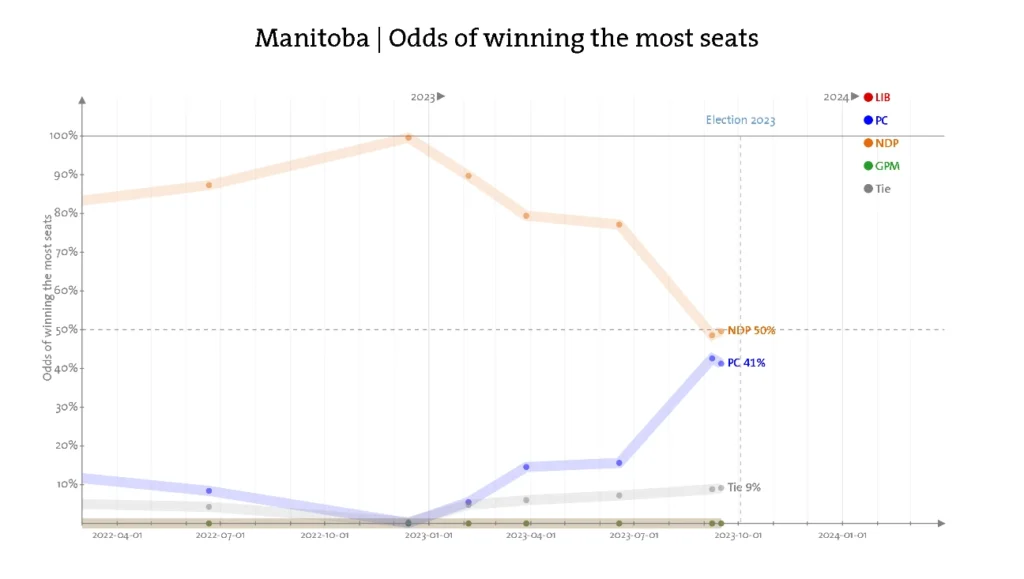
It need not always be so; we need not live always like this. All that is needed to avoid it is a common public will to reject such politics, and a common language with which its alternatives can be expressed. It is to be hoped that Wab Kinew, and his Manitoba NDP, can manage to find both. If they do not, then the election outcome in Manitoba hinges largely, at this point, on the forces of inertia. And let me tell ya, one party has got momentum in heaps right now:
The election’s on October 3rd; it’s a Tuesday. Don’t forget to vote, I’ll see you next time for Part III!
-R.
