
…Ah. Yes, well then. Hmm.
Me? Oh, fine, thanks. How have you been?
Alright, okay fine. Well, my last post to this blog was published in November 2019, so I guess the first big update I need to share with you all is that I’m bald now. ‘Bald’, yes — a bald man. It’s not so much that I’ve been hiding the fact, so much as I just haven’t updated any of my socials to reflect this new reality (I’ve never much liked being photographed), and now I feel like it’s been, like, way too long since my actual baldening for the LinkedIn version of me to still look… I don’t know, 23?
…what I’m saying is, towards the end of the process of writing this, I came to the realisation that I sorta have to update my LinkedIn, before I publish it.
I’ll do that today. Honest.
…If you’re reading this on the publication date, and I still have hair on LinkedIn, then listen buddy: “at or before 11:59pm” is all still “today”. It’s gonna happen.
What else…oh! I turned thirty. Yes, thank you! Oh, about three years back. Yeah.
I remember the day, see, ‘cuz I had just started a new role over at Brandish, and the office had put together a really-quite-lovely cake and card pairing for the occasion. Then I came home to find water just pouring all down through the roof and exterior wall of my apartment. So I spent the evening dealing with that, while also drafting a letter in opposition to the rent hike that my landlord had just applied for, like I’d planned to. Also, Wuhan locked down.
Which pretty much brings us up to today; my thirties (and our collective twenties) would seem to have started very much as they mean to go on. On the plus side, it turns out that a major global health crisis, sparking the rapid and society-wide adoption and acceptance of “telework”, has actually been pretty great for me, career-wise if nowhere else.
By the end of 2020, I was out the door at Brandish, and out of that apartment about a year after that. I spent a brief stint at a little boutique agency out of Vancouver, but that didn’t pan out. After that, I took another few months of independent contractor work, before landing at No Fixed Address as part of a then-nascent “Performance Marketing” division.
Fun story, quick story: I got shitcanned from one of those aforementioned roles for fat-thumbing one line in a Meta Ads config, in such a way that the campaigns just so happened to purchase about a senior civil servant‘s annual salary worth of Instagram ad-space over one weekend. I told my boss about it before noon on the Monday, and I was handed my papers by close-of-business Wednesday — my sense was, they wanted a head on a spike that they could display to the client at their next meeting.
Fortunately (and this time, the good kind of fortune), I had managed to prep and send out a formal refund request on that client’s behalf before that agency nuked all my logins. Because the support ticket was linked to my Facebook account, I did hear back from Meta Support that they did issue a refund, agreeing in part with my arguments that the error had stemmed at least in part from certain recent changes to their Marketing API, for which there were other open and/or unresolved bug tickets.
So, that was nice. Thing was, because I no longer worked for any of the parties involved, no one at Meta can actually tell me the amount of the refund they got. Educated guess, I’d say it was about half — so really, I can only claim to have fat-thumbed a junior civil servant’s salary in my career as a media buy (thus far).
More recently, I’ve been settling in over at boa, as their new Paid Media Manager. It’s a very cool outfit, and I’ll be doing a lot of (what I consider) cool shit there. I feel quite pleased at being able to draw in a paycheque from out-of-province. Look at me, Rob Holt: stalwart pillar of the local economy.
I am well, and fairly happy; I hope things are much the same on your end.
And with that, you’re all caught up on what’s been happening with me ever since the start of Quarantimes. Okay? Okay!
Okay. So. Today I’d like to talk to you about the finer points of ratfucking.
Your Agenda for Today’s Meeting:
In my second-to-last post, I attempted an analysis (fueled mainly by polling-day buzz) of the 2019 Manitoba provincial election, by way of the then-novel Facebook Ad Library.
With these next few posts — I envisage a trilogy — I’ll be aiming at something similar, only with the benefit of a few more years’ experience, a markedly improved Ad Library tool, and more than five hours before the polls close.
Well. I suppose we should start with “the recent unpleasantness”.

If you live in Winnipeg (or have even a passing interest in Manitoba politics),you’ve no doubt been exposed to one or more of the various partisan attack ads which ran across the entire city, all throughout May and into June — on billboards, in mailers, in robo-texts, on ads in your Facebook or Instagram feeds — all paid for by a group known as the Canada Growth Council.
If you live outside of Winnipeg (or just haven’t visited in the past couple weeks), you’ve likely no clue what I’m on about. Others might be familiar with the campaign through various local news reports which came out last week (somewhere out there, right now, right this moment, a PR flak somewhere in Saskatchewan is polishing up a slide deck absolutely jam-packed with statistics about “earned media”, softly smiling to themselves).
Most of these ads featured crude photoshops of federal NDP leader Jagmeet Singh, Liberal party leader and Prime Minister Justin Trudeau, and Manitoba NDP leader Wab Kinew, all washed out in NDP Orange.
“CAN’T AFFORD THESE TWO?,” reads the Impact-font heading positioned over the former two, while “IMAGINE ADDING KINEW…” hovers above the latter.
I won’t dwell too long on “the story thus far” (there’s so much more going on!), but being both uniquely qualified to investigate, and exceedingly curious in these respects, I have a few points I’d like to add to this, The Current Discourse™:

- Tom Brodbeck’s June 6th column in the Winnipeg Free Press refers to meetthendp.ca (the website to which the bulk of CGC’s ads directed viewers, which now seems to been taken offline) as “a website it created”.
Here, Mr. Brodbeck leaps to an inaccurate conclusion: in fact, the web-domain meetthendp.ca has been registered since at least 2015, and its administrative ownership would seem to have been passed between several Canadian conservative parties in the years since. Canada Growth Council, Inc. was first incorporated in early 2019, about four years after the first known live use of the domain.- The earliest known archives of meeththendp.ca date to the 2015 federal election, and bear the authorisation of the Registered Agent of the Conservative Party of Canada. “MEET THE NDP,” the header of this version proclaims, “THE PARTY WE JUST CAN’T AFFORD”.
- Archives dating from circa 2018 were authorised by the CFO of the PC Party of Ontario. “If you thought the Wynne Liberals hurt Ontario,” the hero-card reads, “just wait until you meet the NDP.”
- At some point thereafter, the URL started 301-redirecting to some virtually-identical content hosted on the primary domain of the United Conservative Party (known archives of the UCP’s version date back to April 2019). “Meet the Real Alberta’s NDP,” reads its header, “click on an Alberta NDP candidate name to find out who the real NDP are!”
- When asked for comment about the CGC’s recent campaign, Premier Stefanson told local media “I have no knowledge of any interaction, at all.”
- Asked if she herself had received any of the CGC’s recent robo-texts, Premier Stefanson told reporters: “I did [receive a CGC robo-text], but y’know *sighs*, I mean I receive so many messages *laughs*, and uh, but I, y’know, an-and it is what it is, I mean, y’know, uh, but, I did not, y’know, look at it one way or the other, other than, y’know, deleted it *scoffs*“.
- In subsequent statements sent to multiple local news outlets, PC Caucus spokesperson Cameron Eason later asserted that “PC caucus has not had any role with this third party group whatsoever.” Per the CBC’s Bartley Kives, Eason’s statement further clarified that neither the PC Caucus nor the Progressive Conservative Party of Manitoba (these being two distinct entities) claim to have any involvement with the Canada Growth Council.
As will be shown (read on, dear reader), these claims strain credulity beyond its reasonable limits. I would go further still, and say that the balance of evidence suggests it is unlikely that the Party could not have had direct knowledge of the CGC’s efforts, both during their planning phases and in their execution.

What no recent local news reports have accurately captured — in my opinion — is the sheer, ludicrous, nigh-Lovecraftian scale of the CGC’s recent campaign. We’ll return to this point a bit later on, but just to offer some basis for comparison here:
- In my analysis of Facebook Ads spending during the 2019 provincial election, I found that the Manitoba PCs vastly outspent their rivals in 2019, racking up just a hair under $53,000 in ad-spend on that platform over the ninety days preceding Election Day. The Manitoba NDP, for their part, spent ~$15,000 in that time. Meta Ads Library data is unavailable (in Canada) for dates prior to 10 June 2019, so we don’t know if/how much was spent over the first ~30 days of that year’s “pre-election period”.
- Facebook Ads Library showed that the Manitoba Liberals spent ~$10,000, while the Greens spent $0.
- Per Meta Ads library data, over a five-week span between May 1 and the first week of June, Canada Growth Council spent over $50,000 on Facebook Ads alone.
- The group spent almost as much on Facebook Ads in May as have the governing PCs over the past four years.
- In the NDP’s case, that party’s total ad-spend on Facebook since June 2019 is less than what the CGC spent in May 2023.
- There are currently two federal by-elections underway in the province; the CGC has spent more money on Facebook Ads over the past 90 days than has every candidate, running for every party, in both of these ridings, combined. We should note that this list includes Maxime Bernier, leader of the far-right People’s Party of Canada, who is currently campaigning hard in the deep-blue-bordering-on-ultraviolet riding of Portage–Lisgar. Incidentally, do you happen to know the French word for “carpetbagging”? It’s “parachutage“.
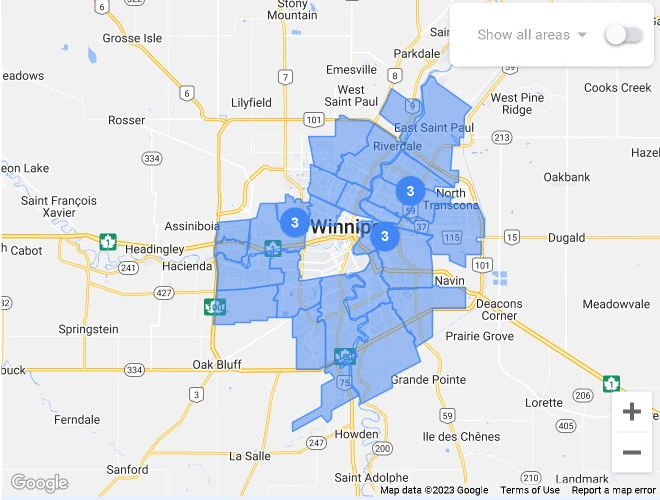
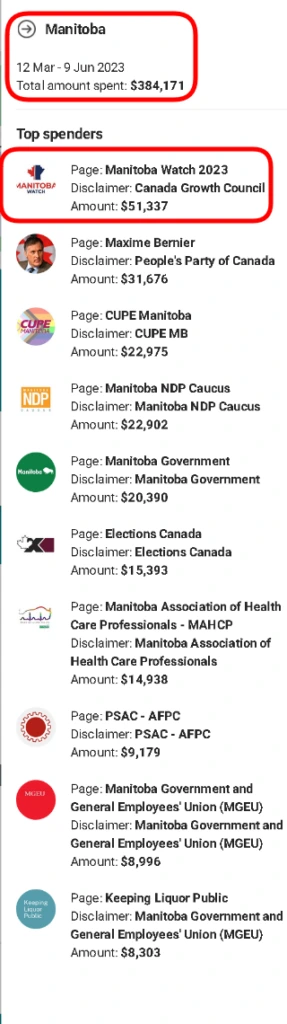
Prior to May 1, ‘Manitoba Watch 2023’ had spent $0.
We are talking about truly comical sums of money having been spent in an effort to influence voter sentiments here in Winnipeg (but then, of course, people will only laugh if — like Glenn Murray in the last civic election — they still don’t win).
This is to say nothing of the various other media channels leveraged by the CGC; anecdotally, the digital billboard within eyeshot of the spot I go to smoke had to have been booked at least 20 percent total share-of-voice all through the month. I’m sure those costs add up, even when you’re buying media in bulk.
The primary objective of the Canada Growth Council’s election activities here in Manitoba (and elsewhere) has been, and will likely continue to be, to suppress overall voter turnout in the provincial capital (more specifically, within its suburbs). Make no mistake: Stefanson’s Tories retain a viable path to holding onto an outright majority government, if only they can manage to hold onto a select handful of suburban ridings, and/or perhaps play a “spoiler” role in one or two current NDP seats which threatened to flip Liberal at the last election.
Wherever possible, CGC is likely to amplify past controversies and/or public remarks by sitting NDP MLAs, often tailoring the delivery of these messages to whichever audience(s) it feels will be most aggrieved. Again, the goal here is not to convince voters to support “their candidates”. The goal is to convince enough of the other side’s potential supporters not to turn out to the polls that a couple of their candidates might squeak out wins, thanks to the vote-split among whatever “progressive” votes still remain. These efforts are likely to have a perceptible impact on voter turnouts at an individual riding level, in and around Winnipeg. As an aside, the Manitoba NDP will likely now be obliged to divert additional campaign resources into supporting a number of urban incumbents, in seats which might have otherwise have deemed “safe” this election cycle.
In these respects, the CGC’s efforts have been, and are, an overt exercise in antidemocracy. I have every confidence in their success.
Better Know a Ratfucker
Let’s start at the start by asking: who are the “Canada Growth Council“?
Well, there’s this ‘Partner’ bio offered by the Canada Strong and Free Network (curiously, the page’s URL started returning a 404 Not Found error a couple of days ago, so I’ve linked an archived version). There’s also the brief “about us” which adorns their former homepage, but let’s not spend too much time unpacking those, since it’s really all just bullshit, innit?
Greater insight might be gleaned by reference to the public records. Per a recent Corporations Canada company profile (the kind that literally anybody with an email address could pull), Canada Growth Council, Inc. was incorporated on January 28, 2019, and is described as a “soliciting corporation”. These are treated a bit like non-profits, and come with a few extra disclosure and reporting requirements than does a typical (federally-registered) private corporation.
One other thing of note:it would appear that the organisation hasn’t made any of its annual filings (required of any Canadian corporation) for at least three years (filings for 2023, 2022, and 2021 are all listed as “Overdue”). Under normal circumstances, this would have resulted in its “administrative dissolution” for non-compliance, but Corporations Canada had/has extended a number of filing deadlines in light of the disruptions caused by the COVID-19 pandemic.
I know this because, despite having never done anything through the federal corporation I registered in April 2019, and having never responded to any of the several reminder emails I got, my absolute, last-chance, drop-dead deadline to avoid administrative dissolution was literally three days ago. Anyways that was a thing I noticed.
Perhaps it’ll be more illuminating to look into the backgrounds of its key players — here are your dramatis personae (click the headings to expand):
Dale Richardson
- One of three current Directors, per Canada Growth Council Inc.’s corporate filings.
- Current role is listed as “Public Affairs Manager” to Paper Excellence, a major pulp-and-paper manufacturer.
- One presumes this role entails working to ensure people don’t read articles like this one, highlighting his employer’s nebulous ownership structure, and its likely financial backing by the Chinese state.
- In 2018, a Director of Digital Operations to the Government of Saskatchewan.
Jarrett Coels
- One of three current Directors, per Canada Growth Council Inc.’s corporate filings.
- For the past 3.5 years, listed as a Manager, Strategic Communications at the Canadian Association of Petroleum Producers (CAPP).
- Served for ~4 years as “Executive Director – House Business and Research” in the Government of Saskatchewan.
- Coels’ LinkedIn profile makes no small account of his time in government: he describes the role as having “led the implementation of government’s legislative agenda as the key strategic advisor to the Premier, Government House Leader and Cabinet”, as well as having “led all major political research projects on behalf of government”.
Kyle Addison
- One of three current Directors, per Canada Growth Council Inc.’s corporate filings.
- Current Chief Operating Officer at Mitchell Properties.
- Current Vice-Chair on the Board of the Regina & District Chamber of Commerce.
- Former Chief of Staff to the Mayor of Regina.
- Former President, University of Regina Students’ Union (served two terms).
Derek Robinson
- Formerly Chief of Digital Strategy in Scott Moe’s Executive Council and Office of the Premier (~2012-2018).
- Left the Premier’s office in 2018 to found Mash Strategy, a marketing and advocacy agency. Pin this little fact in the back of your mind for later.
- Identified in 2019 media reports as a founding Director of Canada Growth Council; also quoted as a “spokesperson” for the group in several news articles.
- It is unclear when Robinson’s name was removed from the CGC’s list of corporate officers.
Eric Clark
- Reputedly, a former member of the Saskatchewan Party’s Board of Directors.
- Presumedly, the same Eric Clark currently listed as a “VP Corporate Development” at Vendasta (a large, Saskatoon-based technology firm which recently secured a $120M round of venture funding).
- Cited as a founding Director of CGC in 2019 media reports; unclear when his name was removed from list of officers.
Tyler Willox
- Per the party’s financial disclosures, the largest individual contributor to the Saskatchewan Party in 2018.
- LinkedIn profile states he is currently a VP at ISM Canada (a wholly-owned subsidiary of American ITC firm Kyndryl).
- Chair of the Regina & District Chamber of Commerce from 2013-2017.
- Cited as a founding Director of CGC in 2019 media reports; unclear when his name was removed from list of officers.
There you have it: the CGC’s known past and present leadership is a veritable who’s-who of the big money, Big Oil, Big Tech bigwigs and backroom big-brains behind what one might charitably refer to as “the Prairie conservatism movement”. You get it. Who cares? I agree.
The final “direct source” I’ve managed to find regarding the Council — and it is, to my knowledge, one of few extant public records that lifts the curtain on what it is they actually do — are the Electoral Campaign Returns which the group were obliged to file with Elections Canada (as were all third party advertisers) after the 2019 federal election.
See,the CGC’s first major claim to fame was their (largely successful) effort to unseat a number of Liberal incumbents during the 2019 election. In western Canada, these efforts mostly ran under the branding of “WestWatch Canada“, whereas in Ontario, CGC operated under the “Ontario Watch” label.
Indeed,the Canada Growth Council is widely credited with engineering the shock defeat of veteran MP Ralph Goodale, who saw his support collapse from 55 per cent at the last election, to 33 per cent; Conservative candidate Michael Kram saw his share of the vote surge by twenty points, despite having (officially) spent roughly four-fifths of what Goodale’s camp did on his campaign.
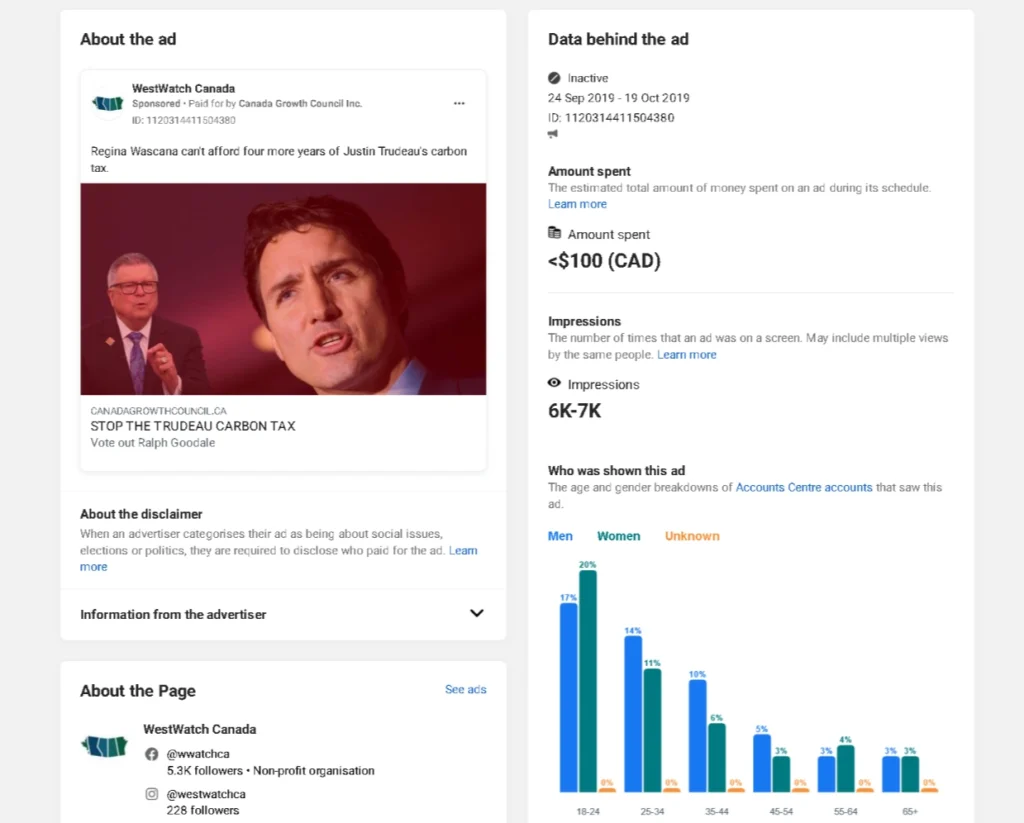
Goodale would later describe the CGC’s campaign against him in Regina—Wascana as “political carpet-bombing”. It is to his great credit (he surely owes his subsequent U.K. ambassadorship to the fact) that he did not in that moment elect to call it what it was: a ratfuck.
Thankfully, there are rules about these sorts of things. So, both during and after the fact, Canada Growth Council. Inc. had to disclose to Elections Canada a number of details of their partisan advertising activities and expenses during the 2019 federal election.
Canada Growth Council’s tactics during the 2019 election largely mirrored those employed in Winnipeg over recent weeks: massive online and out-of-home ad buys, exclusively negative messaging, attacks levelled against individual candidates and tailored to distinct audiences via web-based demographic and behavioural targeting… the whole nine.
I linked to the actual returns above, but they make for dull reading – it’s just fifty pages of spreadsheets. If only there were someone who could visualise an obtuse dataset so as to render its salient details intelligible do up some graphs. Someone like… oh right, that’s me. So let’s get graphin’!
Charting CGC’s 2019 Financial Disclosures to Elections Canada
Reported advertising expenses by Category and by Subcategory | Pre-election period vs. election period
Reported advertising expenses by Subcategory and by Supplier | Pre-election period vs. election period
Declared advertising expenses in the pre-election period per federal riding
[NOTE: I’ve also made the above charts available as interactive Looker Studio reports; links are at the bottom of each accordion section.]
Mapping CGC’s 2019 partisan advertising spend per federal riding
Pre-election period ad expenses per federal electoral riding | Canada Growth Council | 2019 Canadian federal election
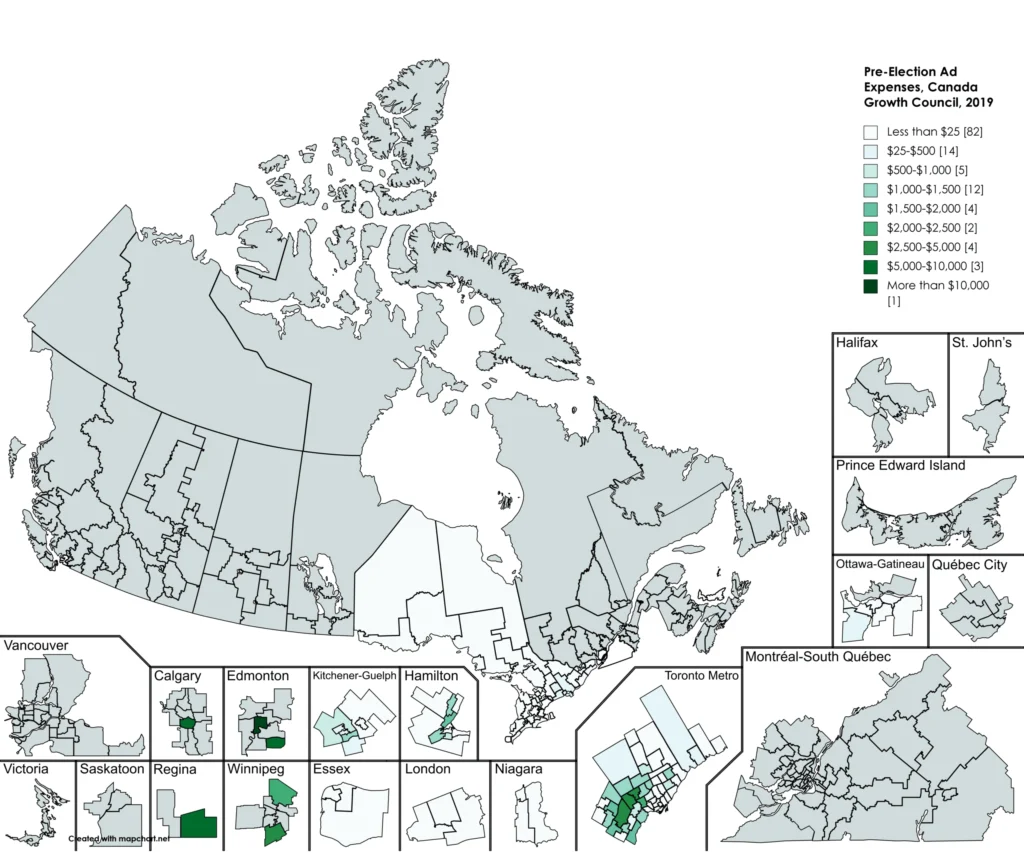
Note: values are omitted for expenses with “place of activity or advertisement” listed as ‘NATIONAL’.
2019 Canadian federal election | Canada Growth Council | Total reported expenses by federal electoral riding
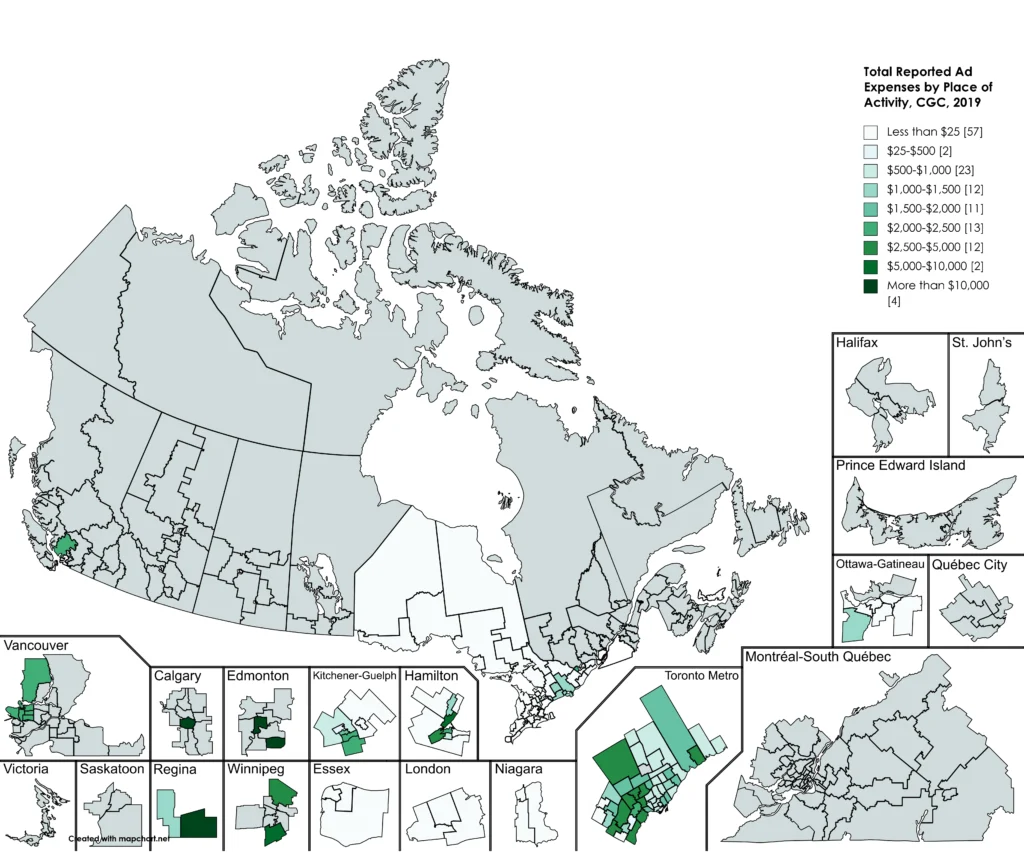
Note: values exclude all expenses where “place of activity or advertisement” is listed as ‘NATIONAL’
2019 Canadian federal election | Electoral results in the ten (10) federal ridings represented by incumbent Liberal MPs targeted by CGC
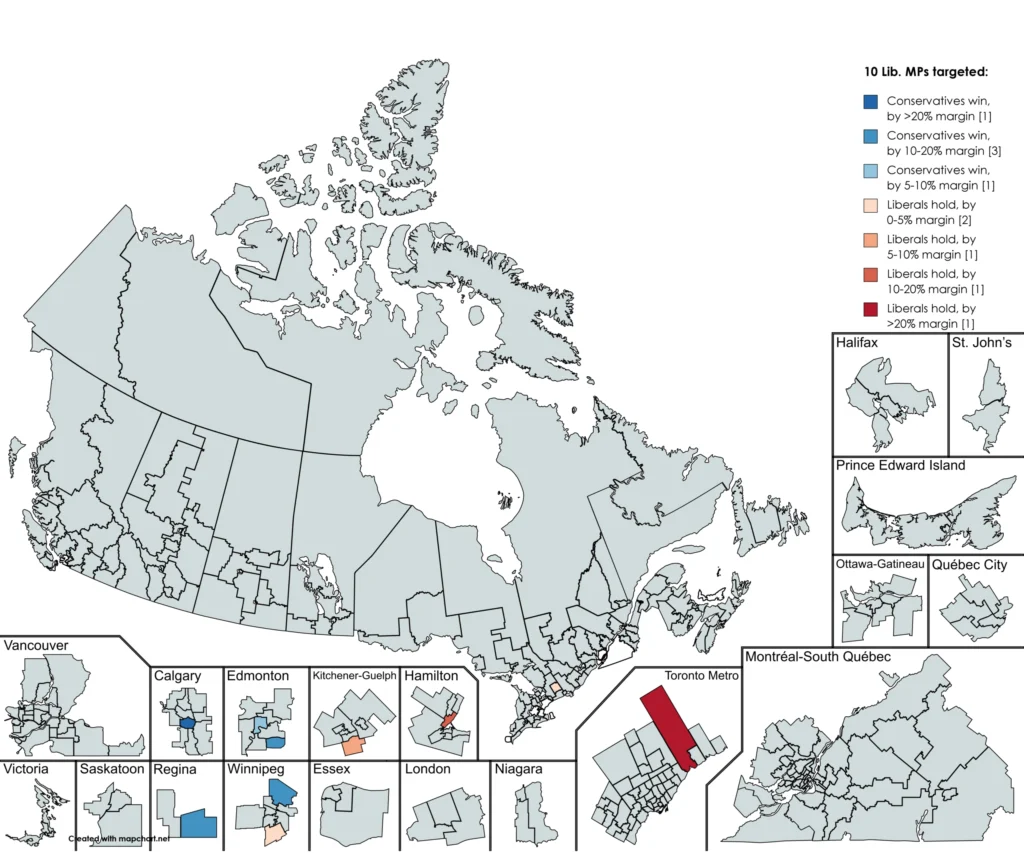
Note: values exclude all expenses where “place of activity or advertisement” is listed as ‘NATIONAL’
That’s too much math! Give me a TL;DR
Fine. But I think my graphs are fascinating.
While the CGC ran partisan attack ads in 2019 across several major media markets from Vancouver to Ottawa, the vast majority of their ad-spend was concentrated on a select handful of ridings in western Canada, in which the Council campaigned aggressively to unseat incumbent Liberal MPs.
A survey of the Meta Ads Library records for ‘WestWatch Canada‘ and ‘Ontario Watch‘ shows that during the 2019 federal election, Canada Growth Council targeted ten incumbents Liberal MPs explicitly (that is, by name) in attack ads targeted at voters in their ridings. These candidates were:
- Liberal MPs targeted by Facebook/Instagram ads published via “WestWatch Canada“:
- Kent Hehr (Calgary Centre)
- Randy Boissonnault (Edmonton Centre)
- Amarjeet Sohi (Edmonton Mill Woods)
- MaryAnn Mihychuk (Kildonan–St. Paul)
- Ralph Goodale (Regina–Wascana)
- Terry Duguid (Winnipeg South)
- Liberal MPs targeted by Facebook/Instagram ads published via “Ontario Watch“:
- Karina Gould (Burlington)
- Bryan May (Cambridge)
- Maryam Monsef (Peterborough–Kawartha)
- Jennifer O’Connell (Pickering–Uxbridge)
All four of the Liberal incumbents targeted by “Ontario Watch” were re-elected (although Maryam Monsef, the Minister for Women and Gender Equality, was returned by a margin of less than five per cent). CGC’s far more intensive efforts in Western Canada, however, proved far more successful; of the six Liberal incumbents targeted by “WestWatch Canada”, only one was returned to Parliament (Terry Duguid of Winnipeg South). And even then, the overall voter turnout for that riding dropped by roughly six points compared to the election prior, while Minister Duguid saw its personal vote-share decline by a little over 16 per cent.
In case you were curious, the CGC’s line of attack against Minister Duguid was that he’d been one of the “background bodies” at a press conference at which Justin Trudeau discussed the resignation of Jody Wilson–Raybould, during the height of the SNC–Lavalin affair. Like, that was literally it. That was the grievance. I won’t lie; I’ve seen better lines of critique. And this one almost worked!
Speaking of Winnipeg, the CGC’s effort in Kildonan–St. Paul (against MaryAnn Mihychuk) is notable as the group’s only “all-digital” campaign anywhere west of Ontario (and a successful one, at that). Their election returns show $0 in spending for signs or mailers specific to that riding, but about $2,000 for Facebook Ads during the pre-election period, plus another $1,000 during.
The principal benefactor of that effort, the Honourable Raquel Dancho, was elevated to Parliament by the people of Kildonan–St. Paul with 45 per cent of the popular vote in 2019. Mihychuk, the Liberal incumbent, saw her vote-share collapse by almost fifteen points. Then aged 29, Minister Dancho’s prior political experience mainly comprised of a “sacrificial lamb” candidacy for the Manitoba PCs in 2016, in the reliably progressive urban provincial riding of Wolseley. In that contest, four out of every ten votes went to the incumbent NDP minister; another three went to the Manitoba Green Party. Dancho has since gone on to greater prominence through her front-bench role as federal shadow minister for Public Safety (since November 2021).
Of course, no federal riding saw more of the Canada Growth Council’s money poured into it during that contest than Regina–Wascana. There, the CGC managed to unseat one of the elder statesmen of the Liberal Party of Canada; indeed, every single riding in Saskatchewan elected a Conservative in 2019. To accomplish this feat, the CGC — per its reported expenses — spent a little over $15,000CAD in total on partisan ads targeting Minister Ralph Goodale (by many accounts, a well-regarded and highly capable parliamentarian). And again: since the start of last month, the CGC has poured over $50,000CAD into attack ads on Facebook and Instagram alone, targeting suburban Winnipegers. And that’s before we even talk about the billboards.
Before we move on, I would be remiss if I didn’t include this curated selection of ad creatives run by Canada Growth Council-controlled properties during the 2019 federal election. You can expand the section below to take a look-see, but I can sum up the Canada Growth Council’s overall output with two words:
Clumsy Analytica.
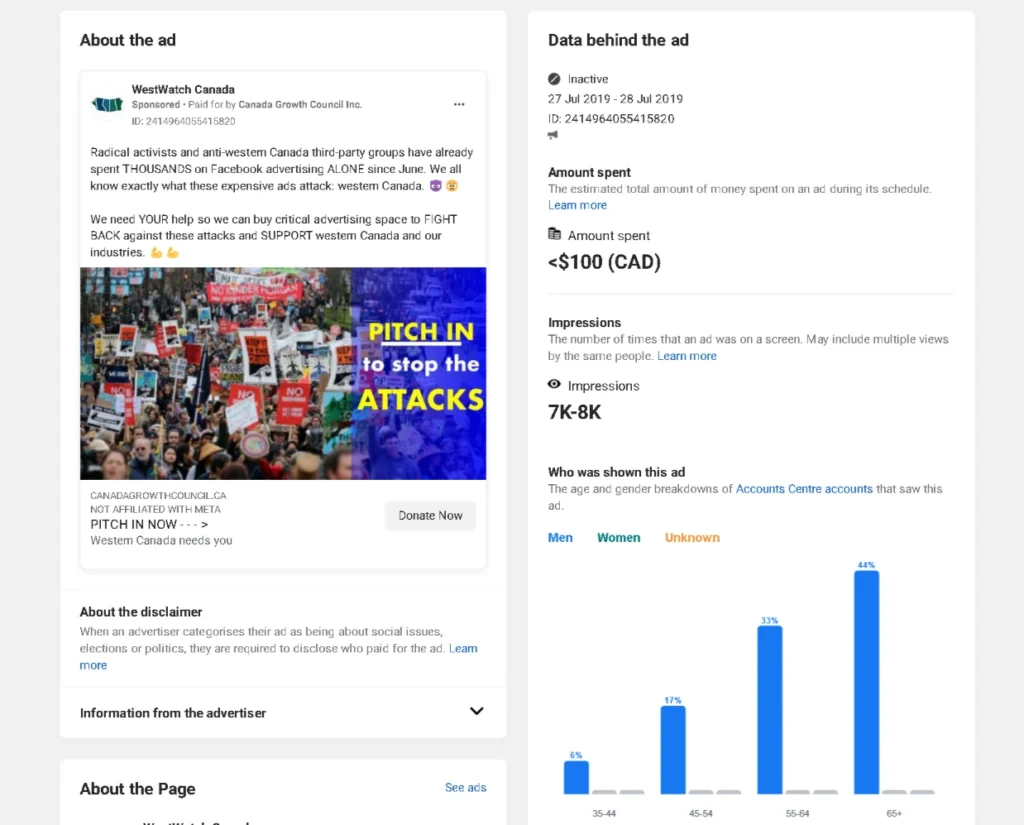
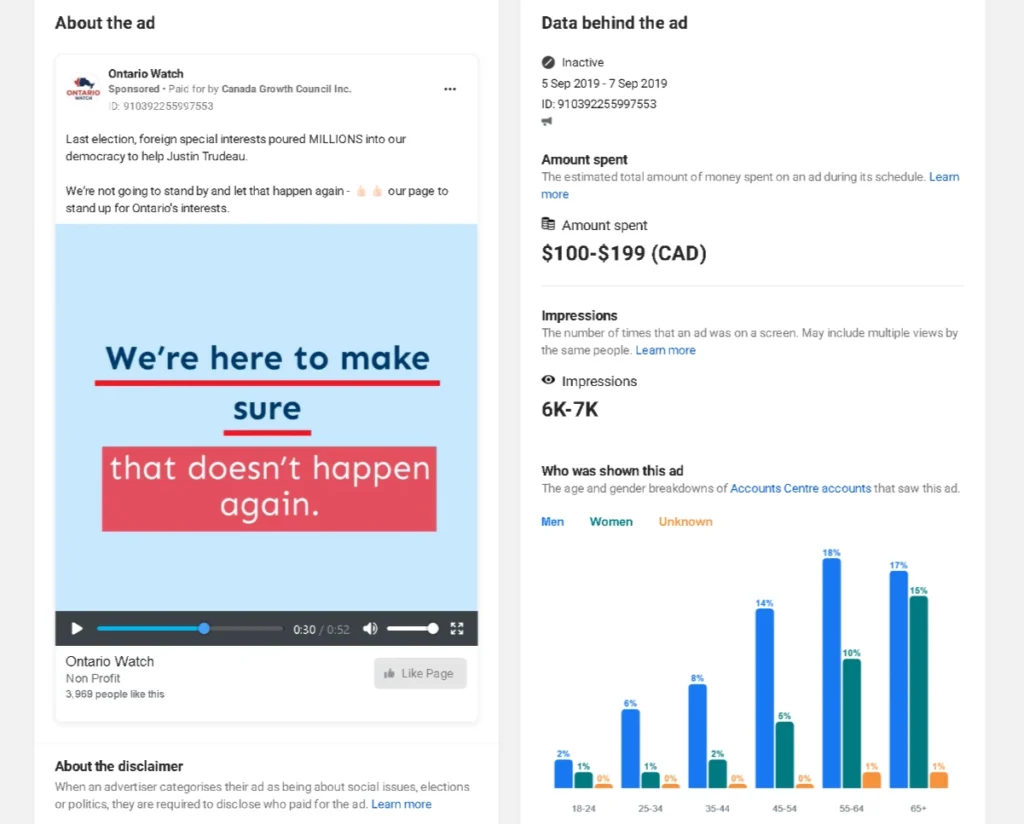
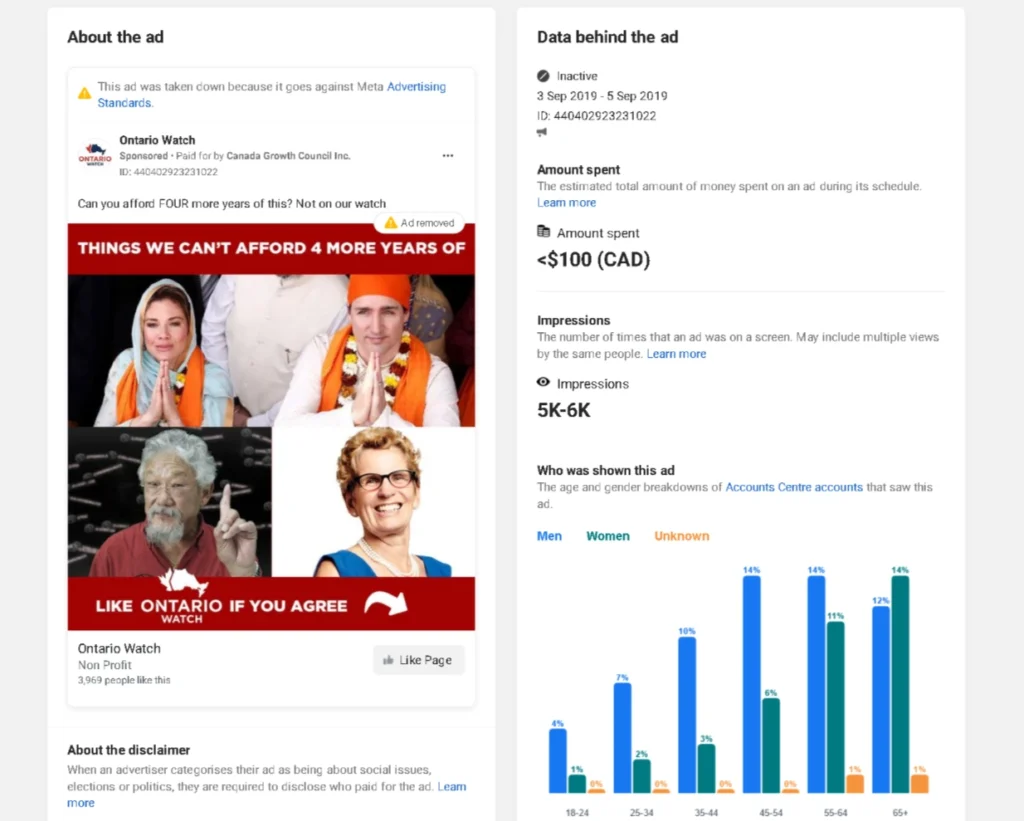
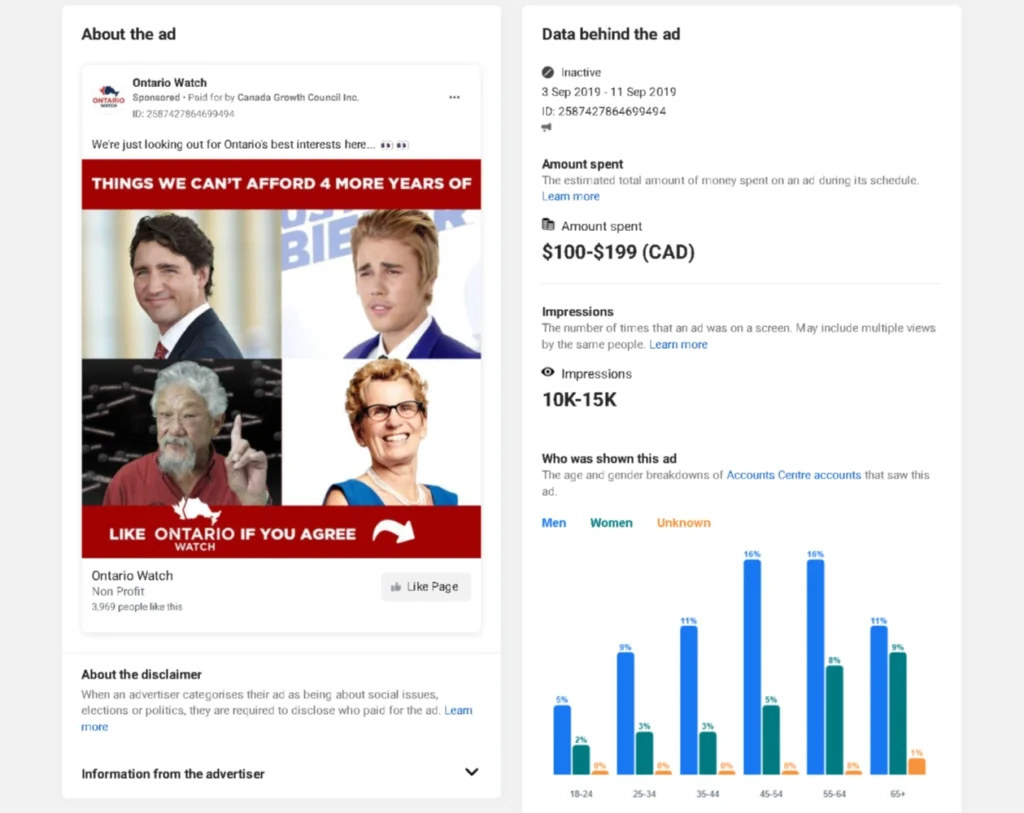
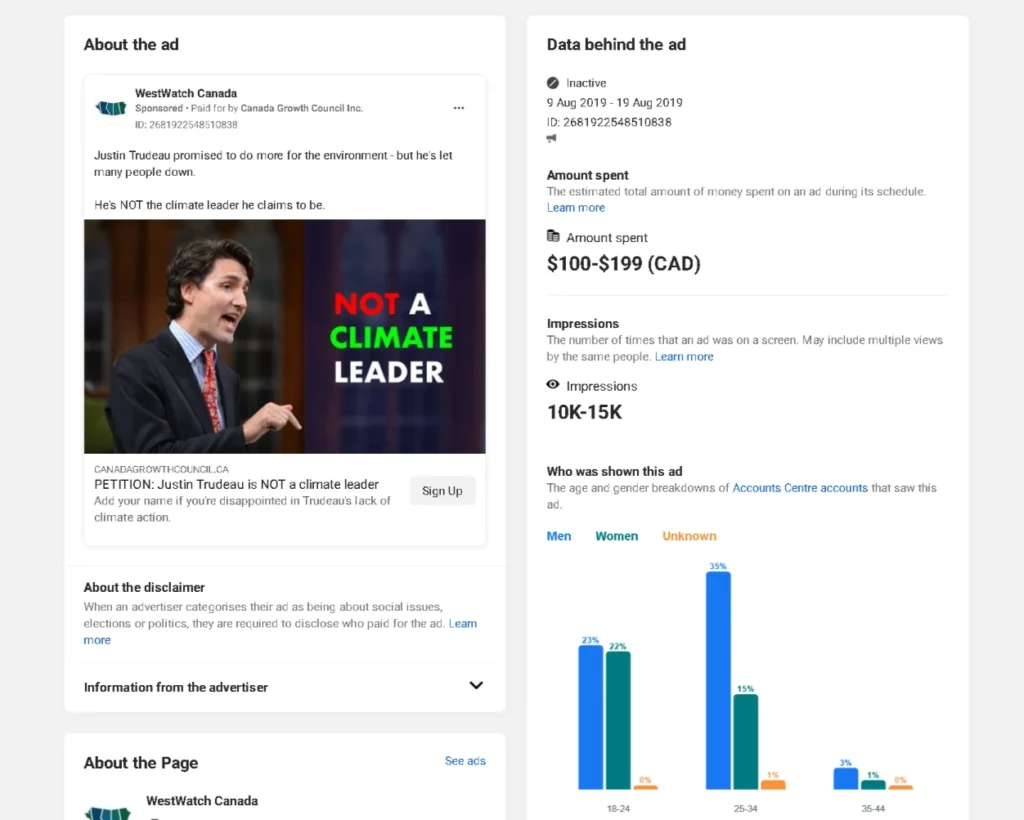
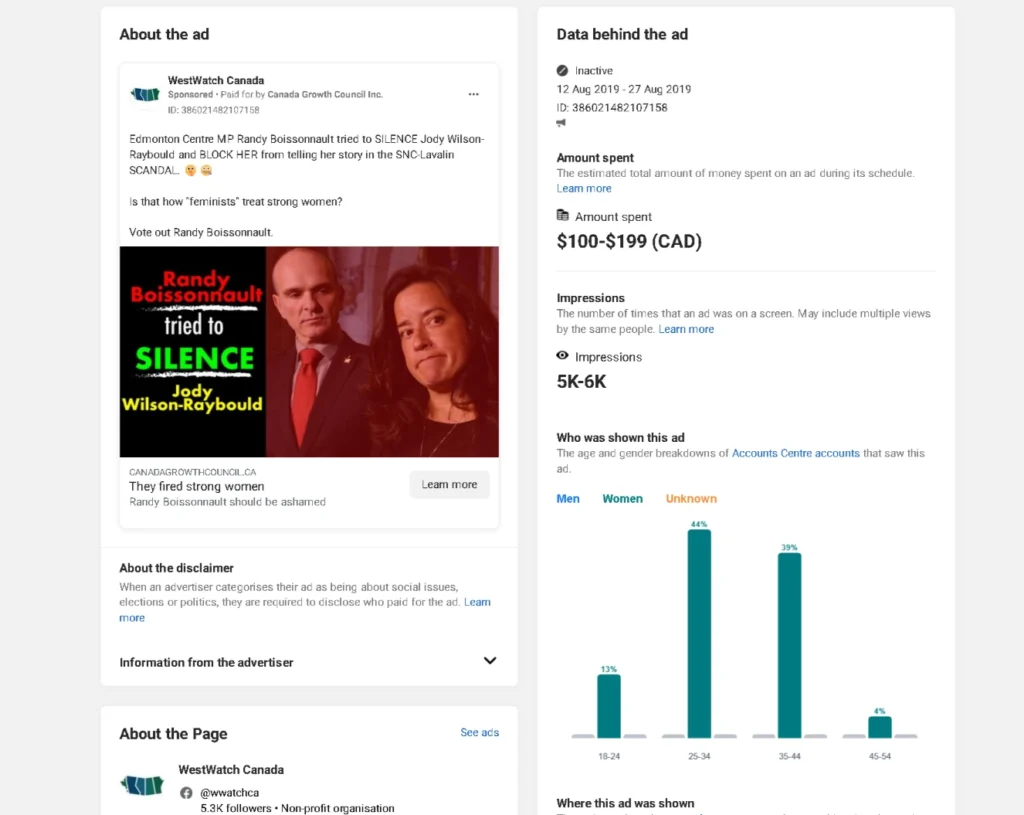
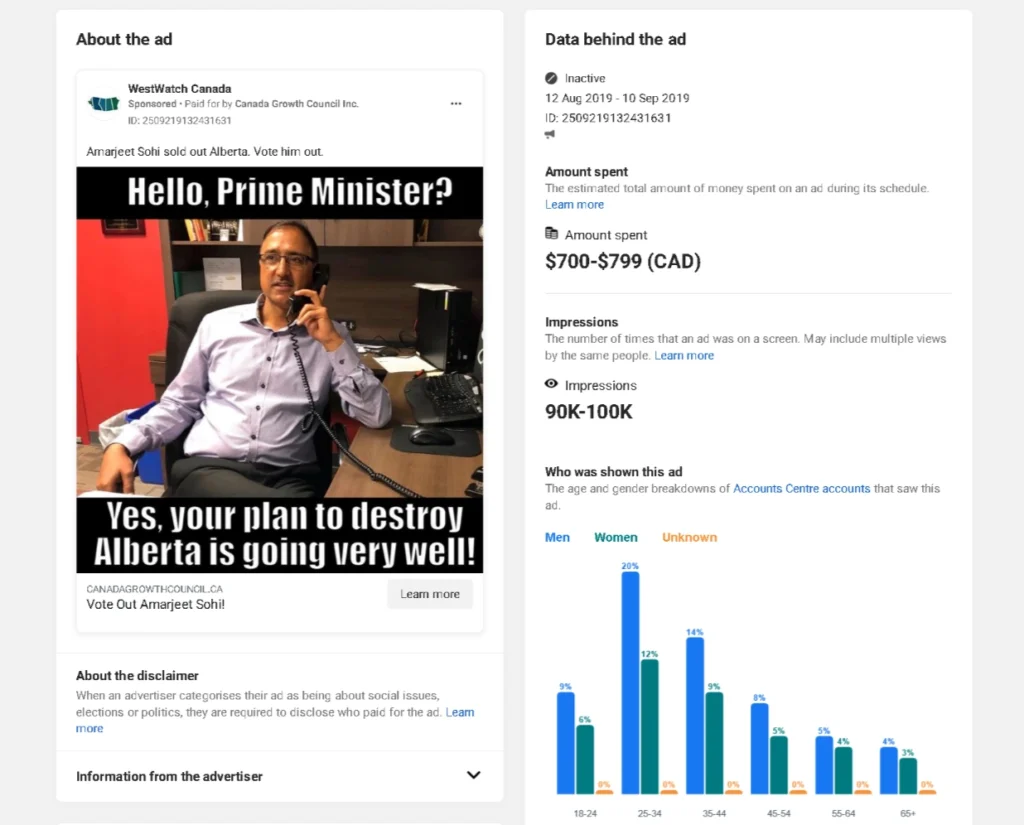
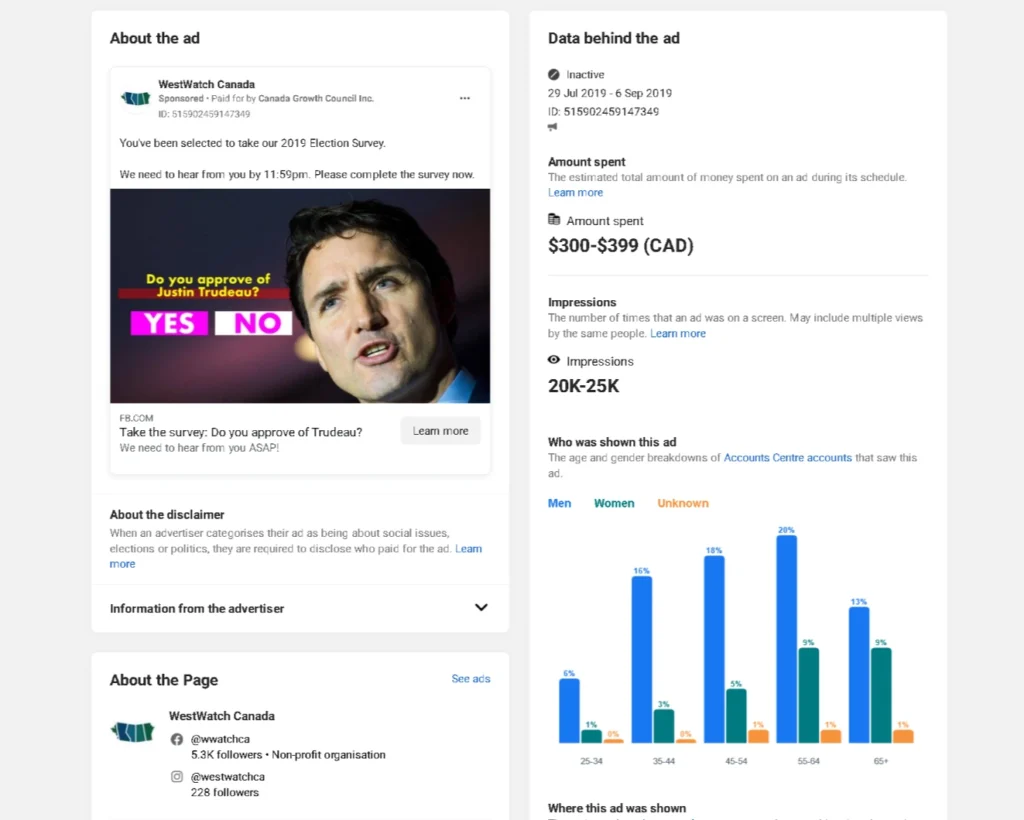
Hello, Police? Yes, I’d like to report a… idk, something?
I should emphasise that nothing I have described is unlawful. Indeed, its formal validity is the very essence of any good ratfuck: that no matter how craven, how cynical, how greasy one’s tricks might be, there’s nothing in the rules that explicitly says they can’t.
Of course, limits are put in place from time to time. Here in Manitoba, the bulk of the legislation relevant to these matters is found in The Election Financing Act, of which Part 12 deals with third-party spending…
83 ELECTION COMMUNICATION EXPENSE LIMITS
(1) — Spending limit during election period
A third party must not incur election communication expenses of more than $25,000 for election communications in the election period for a general election.
(2) — Spending limit for pre-election period
A third party must not incur election communication expenses of more than $100,000 for election communications in a pre-election period.
89.2 ELECTION COMMUNICATION EXPENSES AS ADVERTISING EXPENSES
If a third party incurs election communication expenses with the knowledge and consent of a registered party, those expenses are considered to be advertising expenses of the registered party under Parts 7 and 8.
91 OFFENCES
(1) — Third party exceeding limit on election communication expenses
Every person or organization who, being a third party, contravenes section 83 (election communication expense limit) is guilty of an offence and is liable on summary conviction,
(a) in the case of an individual, to a fine of not more than $5,000, and
(b) in the case of an organization or corporation, to a fine of not more than $50,000.
(2) — Additional penalty
In addition to the fine under subsection (1), a person who is guilty of an offence under that subsection is liable to a fine of up to twice the amount by which the third party exceeded the election communication expense limit.
Summarising the excerpts above:
- Registered parties and third-party political advertisers both face strict limits on the size and scale of their media budgets during a 90-day “pre-election period” in Manitoba, and after the writ has been dropped.
- However, unless the provincial Tories opt to call an election early (which the Premier has now promised not to, though she waited until May 2 to announce this), then practically all of the CGC’s recent media blitz will have fallen outside of the regulated “pre-election period”. Again, this is all legal. That is the point. It is a ratfuck.
- Penalties are steep for those found to have exceeded the limits on partisan ad-spending during the ‘regulated periods’ — and potentially crippling at a ‘tactical’ level for those involved, if it were discovered midway through a campaign.
Perhaps the greatest possible risk, then, lies in a hypothetical scenario wherein one of Manitoba’s registered parties coordinated with a third party partisan advertiser, each planning their activities jointly under the presumption that they will be capable of leveraging both “pools” of media budget come election-time.
Were the provincial Commissioner of Elections to identify such an arrangement, and subsequently rule that earlier partisan advertising by the third party shall be treated as though they were the expenses of the registered party, after the third party had incurred the bulk of their planned media expenses, this could decimate the offending registered party’s presumed “remaining budget” to get their message in front of voters, going into the final stretch of the campaign.
…All of which begs the question: has the Canada Growth Council’s recent (and presumedly, upcoming) campaigns targeting NDP candidates been conducted “with the knowledge and consent of” the PC Party of Manitoba? And are that party’s representatives incorrect in claiming otherwise?
It is, and they are. Wait, no sorry, I meant to tease that reveal out for a while longer. Well, shoot. Let’s back up.
Receipt’s in the Bag
You may, at this point, be anticipating a Wagatha Christie-esque tale of subterfuge and sockpuppetry. I regret to disappoint you: the truth is, it only took me, like, one evening to figure this part of the story out. There’s a good chance that I spent more time fiddling with the formatting of this section of the post than I did researching its substance. I cannot overstate how easily the dots are connected.
So: remember Derek Robinson, from earlier? He’s one of the Canada Growth Council’s founding directors, the one who acted as their lead spox back in the 2019 election.
Robinson, you may recall, had by that point left a role as Premier Wall’s “Chief of Digital Strategy” to found Mash Media (now Mash Strategy), a marketing and communications firm whose homepage now boasts of its role in having helped “5 Premiers and National Leaders [get] Elected”.
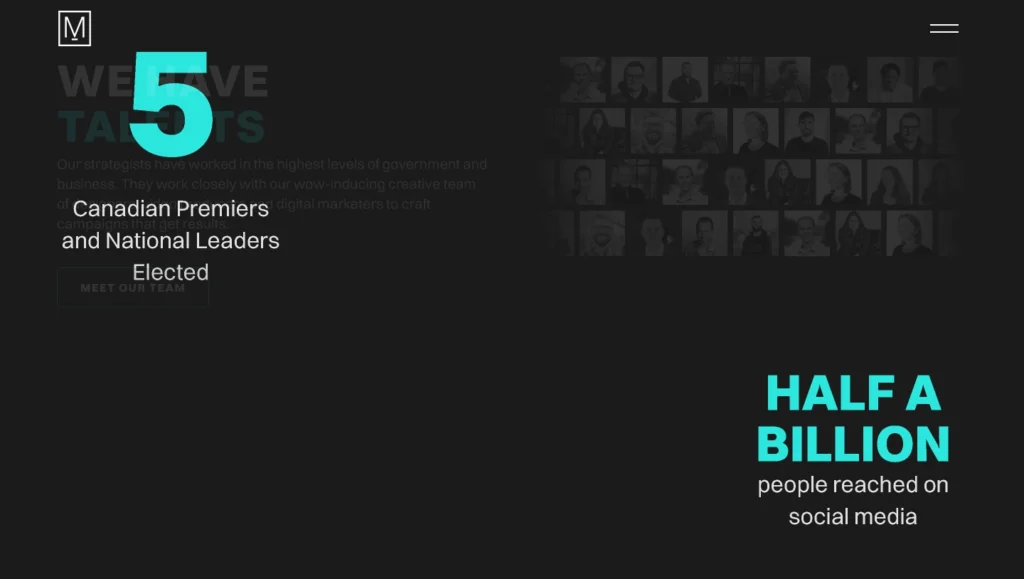
Eagle-eyed readers might also recall this name from CGC’s 2020 financial disclosures to Elections Canada; records show that a little over $10,000 in consulting fees were paid to “Mash Media” by the Canada Growth Council in 2019, for various services rendered during that year’s federal election campaign.
It would also seem that Mash Strategy has enjoyed a close working relationship with Premier Stefanson since at least October 2021. And by that I mean, they tweeted to take credit for having helped her prevail (narrowly) over former MP Shelly Glover in the Manitoba PC leadership contest.
We’re proud to have played a small part in helping @HStefansonMB become Manitoba’s next Premier, and the province’s first female Premier.
Congratulations, Heather and team! https://t.co/f74Px9pVTz— Mash Strategy (@MashStrategyCA) October 30, 2021
Whenever this relationship began (and I’ll grant you, that does sound like the sort of thing somebody really oughta look into), it has surely continued since Stefanson’s leadership win. Notably, one of Mash Strategy’s former graphic designers includes, on their portfolio site, a branding project for the provincial Tories’ Instagram content as a sample of their previous work. It would seem that Mash was also taking work from the PC Caucus during this period, in addition to their work for the PC Party proper:
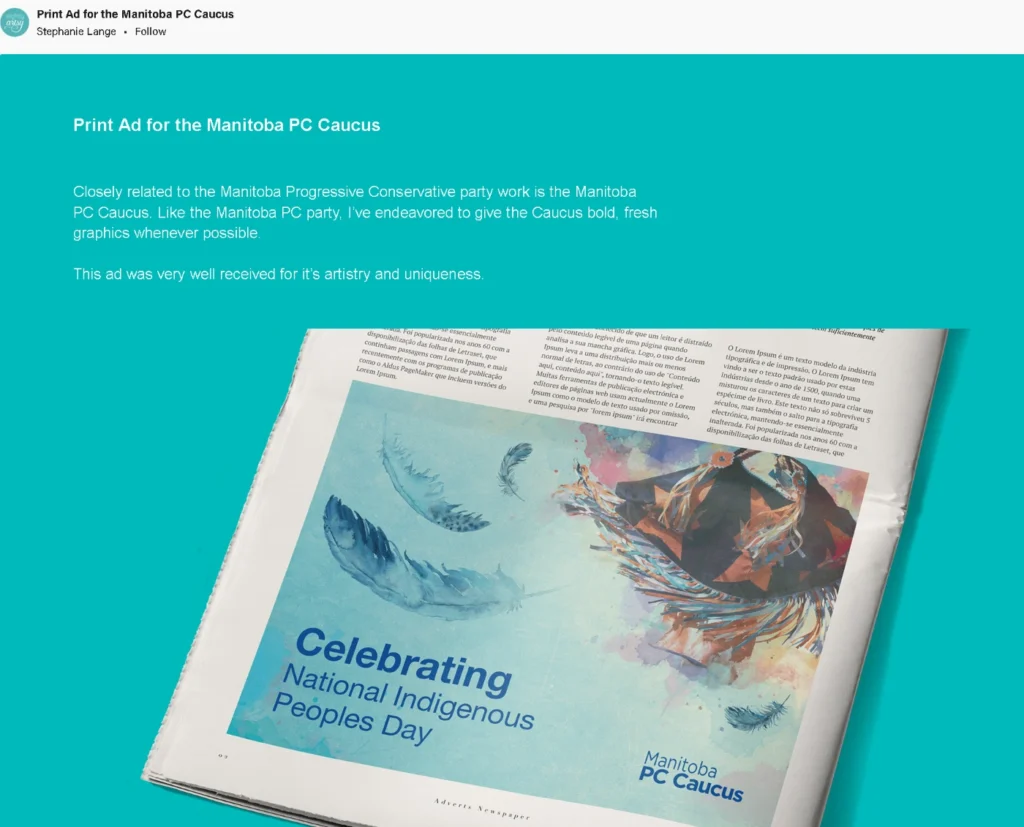

Sure enough, the Meta Ads Library shows that the PC Party of Manitoba’s Meta-based ads began following this new style and branding as early as mid-March 2022. This “look and feel” has largely been followed ever since, with examples dating to as recently as March of this year.
One last thing — from February 2016 to April 2022, the footer of the PC Party of Manitoba’s official website included the following credits: “Powered by NationBuilder | Built by Torch“.
Then, in mid-April 2022, all references to both of these former marketing partners were scrubbed from the site’s front-end and source-code. A Google Analytics tracking property which had been in-place on the website since January 2015 also appears to have been removed at this time. It would seem, although is not conclusively provable from where I stand today, that Mash Strategy assumed responsibility for managing the PC Party of Manitoba’s official website circa April 2022.
(How do I know that last bit, you ask? About two months ago, I compiled a twelve-page analysis of the third-party data collection practices of Manitoba’s major political parties, every year from 2005 to present. Again: I was curious. I sent a copy of it to Brian Topp [who’s apparently managing the NDP’s campaign], but Brian never got back to me, because I gotta do everything around here.)
A Better Breed of Huckster
To recap:
- Canada Growth Council, Inc. is — in the final analysis — a gaggle of extractivists wearing fancy hats. Sometimes they wear the cowboy hats of Western alienation, and sometimes they wear the well-creased baseball caps of populist fiscal conservatism. It seems they don’t really care which hat they wear, as long as it’s plenty shady.
- It remains unclear where exactly the Council’s war-chest is coming from, as the group has failed to make a number of required reporting disclosures.
- The most prominent of the Canada Growth Council’s three founding members, Derek Robinson, founded and continues to lead Mash Strategy. His firm received a little more than $10,000 in consulting fees from the Council in 2019, for services rendered during that year’s federal election.
- Both Robinson and Mash were instrumental to the CGC’s successful efforts to unseat incumbent Liberal MPs across western Canada in 2019 — then leveraging riding-level advertising budgets that pale in comparison to the group’s recent activities in Winnipeg.
- The CGC’s most recent campaign, targeting the suburbs of Winnipeg throughout May 2023, likely dwarfs anything the group has executed before. And the “pre-election period” for Manitoba’s next election only started *checks notes* the Tuesday before last.
- Moreover, the CGC’s May media blitz is without precedent in the modern political history of Manitoba. This will be more clearly illustrated by the group’s financial disclosures to Elections Manitoba, whenever those come out. Assuming that they file ’em. But it’s already demonstrably true.
- Mash Strategy has had a working relationship with the PC Party of Manitoba, in a media and communications capacity, for at least the past 18 months.
- Seemingly, Robinson’s agency has provided marketing services to both the Party and the PC Caucus itself, with this work spanning the domains of social media, website management, and printed communications.
To reiterate: a PC Party spokesperson told local news media “PC caucus has not had any role with this third party group whatsoever”, and when asked by reporters what connection might exist between the Manitoba PCs and the Canada Growth Council, Premier Stefanson stated “I have no knowledge of any interaction, at all”. To which I respond:

I submit that it is not only far more probable, on balance of evidence, that the Premier has had direct knowledge of the CGC’s planned ad-buy for some time (as they have been undertaken by a group founded by the CEO of her Party’s most important digital communications partner), but also that her ultimate choice to hold to Manitoba’s legislated election date for the 2023 provincial election was made with no small reference to that knowledge.
There. That‘s “The Story Thus Far”.
I intend to have “Part II” ready a few days after the “pre-election period” wraps up — should be early September. Don’t worry, it’s gonna be shorter; we won’t have nearly as much ground to cover (knock on wood). In “Part III”, I intend to focus on the writ period: if I can time it just right, I hope to publish that one the minute polls close.
Thanks for reading. Thanks for caring. I’ll talk to you soon,
-R.
